
The rhythmic hum of servers in massive data centers now dictates the pulse of the American labor market more than the traditional ticking of factory clocks or the bustle of downtown office cubicles. As generative artificial intelligence weaves itself into the fabric of every industry from logistics to litigation, the national conversation has shifted from theoretical curiosity to an urgent necessity for economic survival. While these technological advancements promise to unlock trillions in untapped value, they simultaneously threaten to destabilize the livelihoods of millions of workers whose roles may soon be redundant. In response to this seismic shift, a new bipartisan nonprofit organization called RAISE US has emerged to navigate the turbulent waters between innovation and social stability. The initiative seeks to ensure that the march of progress does not leave a trail of devastation in its wake, fostering a future where automation serves the common good rather than the corporate bottom line.
The Bipartisan Strategy for Workforce Stability
Mobilizing States: Integrating Private Capital
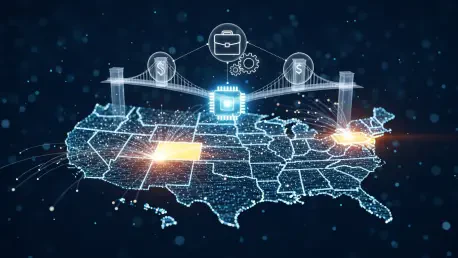
Operating with an initial war chest exceeding $500 million, RAISE US functions as a strategic bridge between high-level policy and grassroots implementation by mobilizing state-level leadership and private capital. This initiative is notable for its bipartisan foundation, led by former Democratic Governor Gina Raimondo and former Republican Governor Eric Holcomb, who have set aside ideological differences to tackle the labor crisis. Their approach recognizes that federal gridlock often stifles rapid response, making individual states the primary laboratories of democracy where new models for education and job training can be refined. By funneling capital into Arkansas, Connecticut, Maryland, and Utah, the organization is testing scalable strategies that can be replicated across the nation. These pilots focus on creating direct pipelines between vocational training and local industry needs, ensuring that state economies remain resilient even as traditional job descriptions dissolve under the influence of automation.
Strategic Partnerships: Engaging Corporate Leaders
The success of this model hinges on its ability to secure deep commitments from anchor partners that represent the vanguard of the modern economy, including technology titans and industrial giants. Companies like Microsoft, OpenAI, UPS, and General Motors have pledged their support, signaling a rare corporate consensus that the risks of mass unemployment are too high to ignore. These partnerships allow RAISE US to gain real-time insights into the specific skills that will be required as AI tools become standard in every workplace. Instead of guessing what the future of work looks like, the organization works directly with the developers of the technology to understand coming shifts before they occur. This collaborative ecosystem encourages a proactive stance, where private companies invest in the human capital they will need to operate their increasingly automated systems. By aligning corporate interests with worker stability, the initiative aims to create a sustainable loop of retraining.
The Societal Risk of Rapid Automation
Quantifying Threats: Balancing Economic Forecasts
The urgency of the RAISE US mission is underscored by sobering economic forecasts suggesting that nearly half of all current occupations in the United States will face significant transformation in the very near future. Current data indicates that approximately 25 million positions could be eliminated by 2030, a timeline that places immense pressure on existing social and economic structures to adapt quickly. Unlike previous technological revolutions that primarily affected manual labor, this wave of generative AI and advanced robotics is penetrating high-level white-collar professions. Experts note that fields such as legal research, diagnostic medicine, and middle management are no longer insulated from the effects of automation. This broad-spectrum vulnerability raises concerns about the potential for widespread societal instability, as the middle class faces a contraction that could erode the foundations of democratic participation. The speed of this transition requires a rethinking of how the labor market functions.
Sector Vulnerability: The Shift in White-Collar Risk
However, not all analysts agree on the trajectory of this disruption, with some political leaders and economists maintaining a more optimistic outlook focused on the growth of new sectors. They argue that the massive push to build AI-related infrastructure, such as advanced data centers and specialized power plants, will generate a hiring boom that could potentially offset the loss of traditional roles. This camp believes that the wealth generated by increased productivity will naturally lift all boats, creating secondary and tertiary jobs that currently do not exist. This ideological divide creates a significant challenge for policymakers who must decide whether to trust in market forces or intervene with aggressive protectionist measures. RAISE US navigates this tension by focusing on the specific, vulnerable populations that are most likely to be left behind if the transition is left entirely to chance. By acknowledging both the risks and the opportunities, the organization seeks to build a consensus that prioritizes human agency.
Modernizing Economic and Educational Systems
Adapting Policy: Building Systems for the Intelligence Era
A fundamental hurdle in the current landscape is that many of the nation’s social safety nets and educational frameworks are essentially relics of the 20th century, designed for a slower-paced industrial world. Traditional four-year university degrees and standard unemployment insurance programs are increasingly seen as ill-equipped to handle the rapid turnover of skills required in the intelligence era. Experts involved with RAISE US advocate for a shift toward intellectual flexibility, which emphasizes continuous, lifelong learning over static credentials. This requires a total reimagining of human capital development, where the goal is to produce workers who can pivot between different roles as technology evolves. The organization is currently exploring ways to modernize these systems by working directly with state governors to bypass the slow legislative processes of the federal government. This localized approach allows for more agile experimentation with curriculum changes that can be updated as new AI capabilities emerge.
Future Resilience: Implementing Structural Market Reforms
To solidify these systemic changes, the initiative moved toward advocating for significant modifications to corporate tax codes that incentivized long-term employee retention and retraining. This strategy focused on creating a practical framework where automation led to new opportunities rather than widespread hardship, moving the national conversation away from doomsday rhetoric. By engaging directly with CEOs and state leaders, the organization established a blueprint for resilient labor markets that balanced technological growth with human dignity. Leaders recognized that the transition required more than just financial investment; it demanded a fundamental cultural shift in how society valued labor and skill acquisition. Moving forward, the emphasis shifted to scaling these pilot programs to every state, ensuring that the entire nation could benefit from the lessons learned in early testing grounds. The primary objective remained the creation of a workforce that was not merely surviving but actively shaping the future.