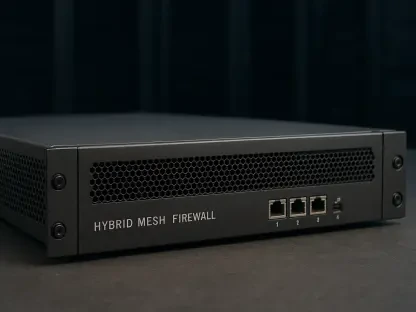

The sheer volume of sophisticated cyberattacks targeting enterprise infrastructure has rendered traditional manual firewall configuration almost entirely obsolete in modern defensive strategies. As threat actors deploy automated scripts to scan for vulnerabilities, the window of time for security teams to respond manually has shrunk from hours to mere milliseconds. Terra Security addressed this critical gap by launching an innovative system designed to automate the generation and deployment of firewall rules, effectively neutralizing exploits before they can penetrate the network perimeter. This development represents a significant shift from reactive security stances to a proactive, software-defined architecture. By integrating deep packet inspection with real-time threat intelligence feeds, the platform identifies malicious patterns and immediately updates policies across the entire environment. This eliminates the risk of human error, which has historically been a leading cause of firewall misconfigurations and subsequent data breaches.
Technological Evolution: The Mechanics of Automation
The underlying architecture of the Terra Security solution relies on a sophisticated orchestration engine that bridges the gap between threat detection and policy enforcement. When an anomaly is detected at any node within the network, the system triggers an automated workflow that analyzes the traffic characteristics against a library of known exploit signatures and behavioral heuristics. Unlike legacy firewalls that require an administrator to write and test a new rule manually, this automated engine synthesizes the necessary parameters—such as IP addresses, port numbers, and protocol types—into a valid rule set. These rules are then subjected to a rapid validation process to ensure they do not conflict with existing business-critical traffic or cause unintended service outages. This seamless integration allows for the dynamic adjustment of security perimeters in a way that was previously impossible without significant manual labor and specialized technical expertise.
Furthermore, the system leverages machine learning models to predict potential attack vectors based on current traffic trends and emerging global threat data. By analyzing metadata from millions of connection attempts, the platform can distinguish between legitimate spikes in user activity and the subtle precursors of a distributed denial-of-service attack or a targeted injection attempt. The transition from static rules to fluid, context-aware policies marks a departure from the “set and forget” mentality that has plagued cybersecurity departments for years. As the industry moves through 2026, organizations can now maintain a hardened security posture that evolves in real-time, responding to the specific nuances of each incoming packet without adding latency to the user experience. This technological leap ensures that security teams are no longer bogged down by repetitive administrative tasks, allowing them to focus on high-level strategic initiatives.
Strategic Implementation: Operational Impact and Security Efficacy
Implementing such an automated framework provides immediate operational relief to Security Operations Centers which are currently facing a chronic shortage of skilled personnel. By offloading the burden of routine rule maintenance, the platform allows engineers to spend more time investigating complex persistent threats and refining long-term defense-in-depth strategies. The operational efficiency gains are particularly noticeable in large-scale deployments where managing thousands of firewall rules across diverse cloud and on-premises environments was once an administrative nightmare. Terra Security’s approach centralizes the management of these rules, ensuring that a single automated update propagates consistently across the entire hybrid cloud fabric. This consistency is vital for maintaining compliance with strict data protection regulations, as it provides a verifiable audit trail of how and why every security policy was changed. Consequently, the speed of deployment for new applications increases.
The adoption of automated security protocols represented a fundamental shift in how organizations conceptualized network defense in an age of constant digital threats. It was found that integrating these systems allowed for a more granular control over traffic flows while simultaneously reducing the overhead associated with traditional IT maintenance. For those looking to secure their infrastructure, the most effective path involved a phased rollout starting with the most critical segments of the network before expanding to broader cloud assets. This method ensured that automated rules were properly vetted against actual usage patterns, thereby preventing any disruption to legitimate business processes. Furthermore, it was determined that the most resilient teams were those that coupled automation with continuous employee training on advanced threat analysis techniques. By establishing these robust frameworks, enterprises effectively insulated themselves against the volatility of the modern threat landscape.