
Rupert Marais serves as a primary authority on endpoint security and the evolving landscape of device-level threats. With a background deeply rooted in cybersecurity strategy and network management, he has spent years dissecting how attackers exploit the trust between users and their digital environments. His insights are particularly vital as we witness a sophisticated shift in phishing tactics, where static replicas are being replaced by dynamic, live-captured environments that can deceive even the most cautious professionals.
The following discussion explores the emergence of “environment impersonation,” a technique that moves beyond simple brand mimicry to recreate a victim’s specific organizational interface in real time. We examine how LogoKit leverages commercial APIs to bypass traditional detection, the transition toward decentralized credential harvesting via Telegram, and the critical role of phishing-resistant authentication in securing the modern enterprise.
How has the strategy behind phishing kits evolved from using static brand replicas to the more dynamic approach we see with LogoKit?
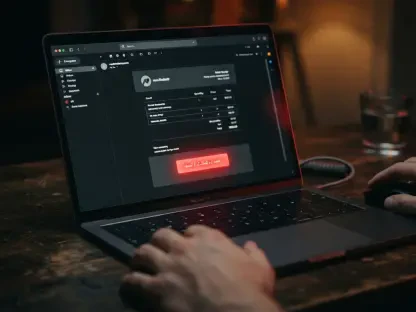
The evolution we are seeing is a move away from “brand impersonation” toward what researchers now call “environment impersonation.” In the past, an attacker would host a static, generic copy of a login page that looked the same for every victim, making it relatively easy for security vendors to create a signature and block it. Today, as highlighted in research from July 29, LogoKit builds a unique login page for each individual victim on the fly. It extracts the victim’s email from the URL, identifies their specific employer, and then uses a commercial screenshot service called Thum.io to capture a live image of the target organization’s actual website. By using this live screenshot as the background, the kit creates a sense of familiarity that is much harder for a user to distinguish from a legitimate internal portal.
In what ways does the use of legitimate commercial APIs and cloud services complicate the job of security investigators?
By leaning on legitimate infrastructure, attackers make their campaigns incredibly resilient and difficult to disrupt. LogoKit doesn’t just rely on its own servers; it calls upon services like Clearbit to supply brand logos and uses the Google Favicon, ImageKit, and Microlink APIs to load authentic imagery as the page renders. This “no server, no template” approach means there is no static indicator for investigators to blocklist or for automated systems to fingerprint. Because each page is assembled at the moment of the request using live data, it bypasses traditional detection methods that look for known malicious signatures. This same level of sophistication was recently noted by researchers regarding the Starkiller kit, proving that the move toward commercial-grade evasion is becoming a standard in the phishing-as-a-service market.
Can you explain the mechanics of how credentials are harvested and how the kit avoids leaving a trace on the victim’s device?
The kit is designed to be “infrastructure-light,” meaning it avoids using an attacker-controlled backend for credential harvesting, which would be a primary target for take-downs. Instead, LogoKit routes stolen credentials through a Telegram bot, allowing the attacker to receive data in real time without maintaining a vulnerable server. Once the victim enters their details, the kit redirects them immediately to the genuine website they were supposed to be on. This is a clever psychological trick because the victim often assumes they simply mistyped their password the first time, especially since they are now looking at the real, legitimate site. This seamless transition masks the theft and delays the victim’s realization that their account has been compromised.
What specific defensive measures should organizations implement to counter these highly adaptive “environment impersonation” attacks?
Organizations must move toward phishing-resistant multifactor authentication, specifically FIDO2 keys and passkeys. These methods are effective because they bind the authentication process to the legitimate domain, meaning a fake page—no matter how realistic it looks—cannot present the correct cryptographic challenge to the user’s device. Beyond hardware keys, we recommend implementing conditional access rules and browser isolation to create a buffer between the user and the web. URL filtering is also essential, but it must be advanced enough to flag newly registered domains and specifically look for links that carry an email address directly in the path. These layers of defense are necessary because the lures themselves, which range from ICANN verification notices to timesheet updates, are written in at least six languages including English, German, French, Spanish, Chinese, and Korean, making them globally pervasive.
What is your forecast for the future of LogoKit and environment impersonation?
I expect environment impersonation to become the dominant form of phishing because it exploits the visual trust we have in our daily work environments. As more kits adopt this “just-in-time” assembly of malicious pages, we will see attackers utilizing even more diverse sets of legitimate APIs to automate the customization process. This will likely lead to a “cat and mouse” game where security tools must transition from analyzing the appearance of a site to analyzing the behavior of the underlying scripts and the reputation of the APIs being called. Eventually, the only truly reliable defense will be the widespread adoption of cryptographic, passwordless authentication that removes the human element of visual verification entirely.