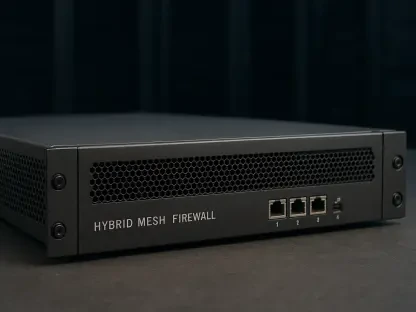

The traditional notion of a secure digital fortress protected by impenetrable firewalls and rigid network boundaries has disintegrated as attackers pivot toward exploiting human identities. Instead of laboring to find obscure zero-day vulnerabilities in complex software code, modern cybercriminals are increasingly finding that the easiest way to breach a multi-billion-dollar enterprise is simply to log in using stolen or phished credentials. This fundamental shift has redefined the security perimeter, moving it from the edge of the network to the very point of user authentication, where a single compromised account can now serve as the skeleton key for an entire organization’s infrastructure. Statistical data indicates that roughly 80 percent of all ransomware incidents now originate through the exploitation of legitimate logins, signaling a dramatic departure from the era when software exploits were the primary concern for IT departments. Consequently, the battle for enterprise security is no longer fought at the firewall alone, but at every individual access point where a user or machine identifies itself.
Structural Weaknesses of Identity Access
Managing Entry Vectors: The Shift to Credential Exploitation
The decline of traditional software flaws as a primary attack vector highlights a calculated move toward the path of least resistance in the global threat landscape. Threat actors are progressively leveraging remote device logins and compromised third-party applications, favoring these methods because they allow them to bypass the most sophisticated external defenses without triggering a single alarm. In the current environment, the reliability of a stolen username and password often exceeds that of a complex malware payload, which might be caught by modern antivirus or endpoint detection systems. By masquerading as an authorized user, a malicious actor can operate within the network for extended periods, carefully mapping out sensitive data locations and backup systems before launching an encryption routine. This stealthy approach effectively negates the massive investments many companies have made in perimeter-based security, as the intruder is treated by the system as a trusted colleague rather than a hostile force.
Beyond the initial entry, the abuse of legitimate credentials facilitates a level of lateral movement that was previously difficult to achieve through purely technical exploits. Once an attacker has secured a foothold with a valid set of credentials, they can navigate the internal architecture of a company by mimicking the standard workflows of an employee. This capability is particularly devastating when combined with the common practice of over-provisioning, where users are granted more administrative rights than necessary for their roles. Security teams often struggle to differentiate between a legitimate administrative task and a malicious action performed by an intruder using stolen administrative rights. As a result, the dwell time for identity-based attacks is significantly higher than for exploit-based breaches, providing hackers with ample time to locate high-value assets and ensure that their ransomware payload will have the maximum possible impact on the target’s business operations.
Limiting the Blast Radius: The Necessity of Just-in-Time Permissions
A significant concern for security leaders is the widespread prevalence of standing access, where employees are granted broad, permanent permissions that they rarely require for their daily professional responsibilities. Currently, the vast majority of corporate access remains permanent rather than being restricted to a just-in-time model, providing attackers with an expansive window of opportunity once they successfully compromise a single set of credentials. When a high-level administrative account is hijacked, the lack of granular permission controls allows the intruder to move across the network with relative ease, infecting server after server while remaining undetected. Implementing rigorous least-privilege principles has become a non-negotiable requirement for limiting the potential damage of a security breach, ensuring that a stolen password does not automatically grant the ability to manipulate the entire enterprise. Organizations must move toward a model where access is ephemeral and specific to the task at hand.
The structural weakness of permanent permissions is further exacerbated by the lack of automated de-provisioning when employees change roles or leave a company. This creates a graveyard of “ghost” accounts with high-level access that provide perfect entry points for attackers seeking to remain anonymous. Modern identity governance frameworks must incorporate automated lifecycle management to ensure that permissions are revoked as quickly as they are granted. By reducing the time a credential remains active and valid, companies can significantly shrink the opportunity window available to ransomware gangs. Furthermore, the implementation of multi-factor authentication is no longer a luxury but a fundamental baseline, though even this must be reinforced with hardware-based keys to resist advanced phishing. The objective is to create an environment where access is treated as a temporary privilege rather than a permanent right, making the environment inhospitable for any intruder who manages to steal a single set of login details.
Modern Threats and Organizational Resilience
Adapting to AI Sophistication: Redefining Identity Verification
The methodology behind credential theft is currently being supercharged by the rapid advancement of artificial intelligence, which has precipitated a massive surge in the quality and frequency of phishing attacks. These AI-generated messages are meticulously personalized and linguistically perfect, rendering traditional security awareness training that focuses on spotting typos or clumsy formatting largely obsolete in the modern era. Machine learning algorithms can now scrape social media profiles and public corporate records to craft convincing narratives that trick even the most cautious employees into revealing sensitive login information. As a result, businesses are forced to transition toward behavioral defense strategies that focus on the context of requests rather than just the appearance of the email itself. Developing instinctive verification reflexes within the workforce has become essential, as technical filters alone are increasingly unable to distinguish between a legitimate internal communication and a deepfake-assisted social engineering attempt.
Despite the undeniable clarity of these emerging threats, many organizations are still severely hampered by a significant lack of internal expertise and insufficient visibility into their own network environments. Numerous cybersecurity leaders admit that they currently lack the specialized tools or the necessary staff to detect identity-based attacks while they are in active progress, creating a dangerous gap between the initial breach and its eventual discovery. Without comprehensive monitoring of user behavior analytics, an attacker using legitimate credentials can go unnoticed for weeks while they exfiltrate sensitive data. To mitigate this risk, businesses are beginning to prioritize identity governance as a core component of their defensive architecture, seeking to identify anomalies in login patterns and geographical access points in real-time. Closing this visibility gap requires a shift toward proactive monitoring solutions that can identify when a trusted identity is behaving in a manner inconsistent with its historical profile.
Future Considerations: Transitioning Toward Proactive Identity Governance
Securing the modern enterprise required a fundamental reassessment of how digital trust was established and maintained across distributed workforces. Leaders recognized that relying on static passwords and broad network permissions invited catastrophe, prompting a shift toward a zero-trust architecture where identity served as the primary control plane. By adopting automated identity governance and just-in-time access protocols, forward-thinking organizations successfully reduced their exposure to ransomware by limiting the utility of stolen credentials. The integration of advanced behavioral analytics provided the necessary oversight to catch sophisticated intruders before they could execute disruptive payloads or move to critical servers. Moving forward, the most effective defense strategy will involve a continuous loop of identity verification combined with a culture of heightened skepticism regarding digital communications. Investing in these specialized identity management technologies and fostering internal security expertise ensured that the most common gateway for attacks became a resilient barrier.