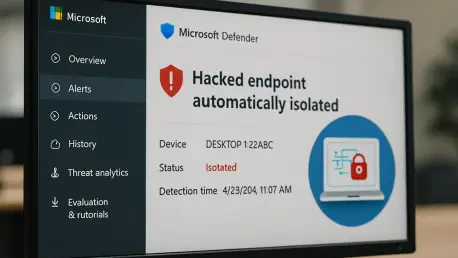

The velocity of modern ransomware attacks necessitates a defensive posture that operates at machine speeds rather than relying on human intervention to mitigate threats before they traverse the network. Microsoft Defender for Endpoint has introduced a sophisticated automated response capability that specifically targets compromised devices to prevent the lateral movement of malicious actors. This development marks a significant shift in how security operations centers manage large-scale environments where manual triage often creates a bottleneck for incident response. By leveraging advanced heuristics and behavioral signals, the system can identify high-confidence indicators of compromise and immediately sever a machine’s network connections while maintaining a management tunnel. This ensures that while a workstation is technically isolated from the broader infrastructure, security administrators can still conduct remote forensics and remediation tasks. Such automation reduces the dwell time of attackers from hours to mere seconds, fundamentally altering the risk profile of endpoint vulnerabilities. Continuous monitoring now integrates deeply with cloud-based signal intelligence to provide real-time updates to isolation triggers.
1. Technical Framework: Mechanisms of Isolation
The technical foundation of this automated isolation resides within the extended detection and response framework, which correlates data points across email, identity, and cloud applications. When a specific threshold of suspicious activity is met—such as unauthorized credential harvesting or the execution of known command-and-control scripts—the isolation protocol activates without requiring an administrator to click a confirmation button. This containment action effectively locks down the network interface, allowing only traffic to the Microsoft Defender for Endpoint service. Unlike previous iterations that required manual tagging, the current implementation utilizes machine learning models to assess the severity of an incident in context. For instance, an unusual PowerShell script on a developer machine might trigger a warning, whereas the same script on a finance terminal would lead to immediate isolation. This contextual awareness minimizes false positives while ensuring that the highest-risk assets are protected. Consequently, the burden on tier-one analysts is significantly lessened, allowing them to focus on root cause analysis.
Beyond simple network disconnection, the isolation process involves a sophisticated series of state-preserving actions that allow for efficient post-attack investigation. The system captures the volatile memory state and active process list at the exact moment of isolation, providing forensic teams with a frozen snapshot of the threat. This is critical in the 2026 threat landscape, where attackers frequently utilize living-off-the-land techniques that leave minimal traces on the physical disk. Furthermore, the isolation feature can be configured to target specific user groups or device categories, ensuring that critical infrastructure remains operational while less vital segments are strictly policed. Organizations can define custom sensitivity levels, allowing for more aggressive isolation on servers containing sensitive intellectual property or personal data. This granular control is vital for maintaining business continuity during a potential breach. By automating the initial containment phase, the security stack creates a buffer zone that prevents a single compromised workstation from becoming the entry point for a domain-wide ransomware deployment.
2. Strategic Deployment: Organizational Resilience
Integrating these automated responses into a broader organizational security policy requires a strategic approach to incident management and exception handling. IT departments must identify which devices are truly mission-critical to avoid accidental outages that could disrupt essential services or production lines. Microsoft Defender provides exclusion capabilities that allow certain high-availability servers to remain online even under high-threat scenarios, though they are still monitored with heightened scrutiny. This hybrid approach ensures that automation does not become a double-edged sword that inadvertently causes a self-inflicted denial of service. Moreover, the transition to automated isolation encourages a more proactive security culture where the focus shifts from reactive firefighting to the continuous optimization of detection logic. Security teams are now tasked with refining the playbooks that govern how the automation behaves, rather than manually responding to every low-level alert. This shift in operational focus represents a maturation of the cybersecurity industry, where human expertise is reserved for complex decision-making.
The implementation of automated device isolation served as a transformative milestone for organizations seeking to harden their digital perimeters against increasingly sophisticated adversaries. To maximize the effectiveness of this technology, administrators audited their current asset inventories to ensure that all endpoints were properly enrolled in the advanced protection suites. They established clear communication protocols between security teams and business unit leaders to mitigate the impact of unexpected device lockouts during critical operations. Furthermore, the adoption of a zero-trust architecture complemented the isolation features by ensuring that even isolated devices had no residual access to cloud-based resources or identity providers. Regular testing of the isolation triggers via simulated breach-and-attack exercises allowed teams to verify that the containment logic functioned as intended under various conditions. Ultimately, the transition to an automated containment model provided the necessary speed to outpace automated threat actors, ensuring that digital assets remained resilient in a volatile environment.