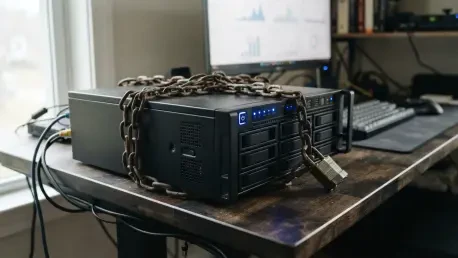

Security flaws like CVE-2024-50629 and CVE-2024-10445 represent significant risks for organizations that have failed to move to the latest DSM security patches. These vulnerabilities allow attackers to bypass traditional defenses and gain unauthorized access to data stored on network-attached storage units. As more businesses rely on decentralized storage solutions to manage their burgeoning data workloads, the value of these repositories has increased, making them prime targets for sophisticated cybercriminal syndicates. The Taiwanese manufacturer Synology recently issued an urgent warning to its global user base because of a massive uptick in malicious activity specifically targeting the DiskStation Manager operating system. This surge is not merely a localized phenomenon but part of a coordinated effort by threat actors to exploit legacy systems that remain exposed on the public internet. Failure to address these critical gaps leaves sensitive intellectual property vulnerable to encryption and eventual extortion schemes.
Technical Analysis: The Mechanics of Modern Ransomware Exploits
The Vulnerability: Anatomy of DiskStation Manager Flaws
The technical core of the current crisis involves a series of critical vulnerabilities that allow for arbitrary code execution and unauthorized file manipulation. One of the most dangerous flaws, identified as CVE-2024-10441, provides a gateway for remote attackers to execute commands with elevated privileges without requiring user interaction. By exploiting these weaknesses, hackers can bypass authentication mechanisms and plant malicious payloads directly onto the network-attached storage architecture. This process effectively turns a secure storage solution into a staging ground for wider lateral movement across a corporate network. For organizations running outdated iterations of the system, the risk is compounded by the fact that many of these devices are configured with default settings that prioritize ease of access over strict security protocols. Consequently, the intersection of unpatched software and high internet visibility creates an ideal environment for automated scripts to scan and compromise systems.
The Resurgence: Historical Context of the Cerber Model
Current data from cybersecurity monitoring services indicates that over 380,000 Synology appliances remain directly accessible via the public internet, representing a vast attack surface for the C3RB3R ransomware group. This threat, often referred to as Cerber, represents a resurrected ransomware-as-a-service model that dominated the landscape in previous years and has now returned with more sophisticated encryption algorithms. The resurgence of this specific malware strain highlights a growing trend where threat actors repurpose proven codebases to target modern internet-facing infrastructure. By focusing on devices that lack the latest security updates from the late 2024 patch cycle, the attackers ensure a high success rate for their campaigns. This strategic targeting demonstrates a deep understanding of the sluggishness often associated with enterprise-wide firmware updates. As long as a significant number of appliances remain disconnected from the latest security patches, the incentive for groups to continue scanning will remain high.
Strategic Defense: Implementing Robust Storage Integrity Protocols
The Remedy: Mandatory Patching and Firmware Updates
To effectively counter the threat posed by C3RB3R, administrators must prioritize the immediate deployment of the latest DiskStation Manager updates across their entire fleet of devices. Depending on the hardware generation, this involves moving to versions such as DSM 7.2.2-72806-1, 7.2.1-69057-6, or even 6.2.4-25556-8 for older appliances. These specific patches were designed to close the loopholes exploited by various vulnerabilities that allow for unauthorized reading and writing of system files. Beyond manual updates, enabling automatic update features within the control panel provides a critical layer of ongoing defense against future zero-day threats. This transition from a reactive to a proactive security posture ensures that even if a new vulnerability is discovered, the window of opportunity for an attacker is significantly narrowed. For many businesses, the simple act of standardizing firmware versions across all storage nodes is the single most effective deterrent against mass-exploitation tactics utilized today.
The Perimeter: Strengthening Access and Network Isolation
The defensive landscape underwent a significant shift as organizations finally acknowledged that internet-exposed storage was an unsustainable risk. Administrators who acted decisively to patch their systems and isolate management interfaces successfully avoided the devastating impact of the C3RB3R resurgence. Those who integrated immutable backups and multi-factor authentication established a resilient framework that allowed for rapid recovery from encryption attempts without financial loss. Looking ahead from 2026 to 2028, the focus shifted toward continuous monitoring and the implementation of automated threat detection tools that could identify suspicious file activity in real-time. The lessons learned from the 2024 vulnerability cycle highlighted the necessity of a rigorous lifecycle management policy for all networked hardware. By the time the next wave of sophisticated malware emerged, the standard of security had evolved to emphasize isolation and rapid restoration, providing a roadmap for maintaining storage integrity.