
The immense popularity of everyday software utilities creates a landscape of trust that cybercriminals are increasingly adept at exploiting through highly convincing fraudulent websites and sophisticated malware. A newly uncovered campaign is leveraging the trusted name of the WinRAR file archiver to distribute a potent backdoor trojan, ensnaring users who venture beyond official download sources. This operation serves as a stark reminder that even the most benign-seeming software can be weaponized, turning a simple download into a significant security breach. The attack’s architecture reveals a multi-stage infection process designed with a singular focus on stealth and evasion, making it a formidable threat to unprepared users and organizations. Its success hinges on a meticulous blend of social engineering, technical obfuscation, and adaptive malware deployment that highlights the evolving nature of cyber threats.
The Anatomy of the Attack
This campaign demonstrates a high level of sophistication, from the initial lure to the final payload delivery. The threat actors have carefully constructed each stage to bypass defenses and ensure the successful installation of their malware.
The Lure of Legitimacy
The attack vector begins with a series of fraudulent websites designed to perfectly mimic the official WinRAR download page, using domain names such as winrar-tw.com, winrar-x64.com, and winrar-zip.com to enhance their appearance of authenticity. These sites are often promoted through various channels across the web, particularly on Chinese-language platforms, directing a steady stream of unsuspecting users to the malicious installers. The downloaded file, typically named something like winrar-x64-713scp.zip, appears to be a standard software package. This initial step is critical, as it preys on user habits and the implicit trust placed in well-known software brands. By creating a nearly identical user experience to the legitimate download process, the attackers effectively lower the victim’s guard, making them more likely to proceed with an installation that is, in reality, a carefully disguised trap. This method is far more effective than random phishing attempts because it targets users who are actively seeking the software, ensuring a higher probability of engagement and infection.
A Multi-Layered Deception
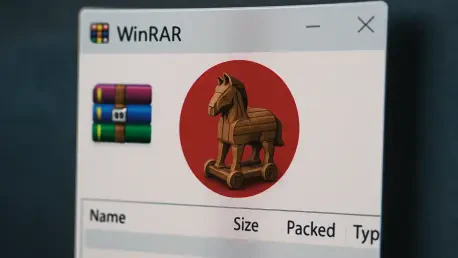
Upon execution, the downloaded file reveals a complex, multi-stage delivery system engineered for maximum stealth. The initial executable is packed using UPX, a common compression tool often used by developers to reduce file size but also frequently co-opted by malware authors to obfuscate their code and hinder analysis by security researchers. This compressed file acts as a dropper, containing two separate components embedded within it. The first is the legitimate, fully functional WinRAR installer, which runs as expected to create a convincing illusion for the user. While this benign installation is proceeding, the second, more sinister component is discreetly activated. This element is a password-protected, malicious archive named setup.hta, which is unpacked and executed in the background without any user interaction or visible indicators. This dual-payload strategy is a classic Trojan horse technique, ensuring that the user remains unaware of the malicious activity occurring in parallel with the seemingly normal software installation they initiated. The use of a password-protected archive adds another layer of evasion, preventing automated security scanners from easily inspecting its contents.
Evasion and Payload Delivery
The malware’s design prioritizes remaining undetected while establishing a persistent foothold on the compromised system. This is achieved through advanced execution methods and an adaptive payload that customizes the attack for each victim.
Evading Detection with Advanced Techniques
One of the most sophisticated aspects of this malware is its use of a memory-resident execution technique. Instead of writing the malicious setup.hta file to the hard disk where it could be scanned and detected by traditional antivirus software, the dropper unpacks and executes it directly in the system’s memory at runtime. This “fileless” approach is a hallmark of advanced threats because it leaves behind minimal forensic evidence on the storage drive, making detection and post-infection analysis significantly more challenging. By operating within the system’s RAM, the malware can effectively bypass security solutions that primarily focus on scanning files at rest. This method allows the threat to persist and carry out its objectives under the radar, often for an extended period. The complexity of this technique suggests that the developers are well-versed in modern evasion tactics and are targeting users who may be relying on outdated or insufficient security measures that are not equipped to monitor and analyze in-memory processes for malicious behavior.
The Final Payload Winzippers Malicious Purpose
Once the malware has successfully established its presence on the system, it proceeds to the final stage of the attack: deploying the Winzipper backdoor. Before doing so, it performs a reconnaissance phase by accessing Windows profile information to create a detailed profile of the compromised machine. This adaptive capability allows the attackers to tailor their subsequent actions, potentially deploying different secondary payloads or adjusting their tactics based on the victim’s environment, such as whether it is a personal computer or part of a corporate network. The Winzipper trojan itself provides the attackers with complete remote access and control over the infected device. This turns the machine into a compromised asset that can be used for a wide range of nefarious activities, including exfiltrating sensitive personal or financial data, manipulating system settings to disable security features, installing additional malware like ransomware or spyware, or incorporating the computer into a botnet for use in larger-scale attacks. All of this occurs silently, while the malware continues to masquerade as a legitimate utility.
Fortifying Defenses Against Sophisticated Threats
The investigation into this campaign underscored the critical importance of user vigilance and robust security practices in the face of increasingly sophisticated cyberattacks. The threat actors’ strategy of bundling malware with popular, trusted software in a multi-stage, evasive package revealed a calculated effort to circumvent conventional defenses. The analysis concluded that the most effective mitigation strategy involved a two-pronged approach. First, it was imperative for users to source all software downloads directly and exclusively from official developer websites, thereby eliminating the primary risk of encountering a trojanized installer. Second, the deployment of a modern, reputable anti-malware solution capable of monitoring memory-resident processes and runtime behavior was identified as essential for detecting and neutralizing such advanced, fileless threats. This incident served as a powerful illustration of how established user trust could be weaponized and why a proactive, layered security posture was no longer optional but a fundamental requirement for safe digital engagement.