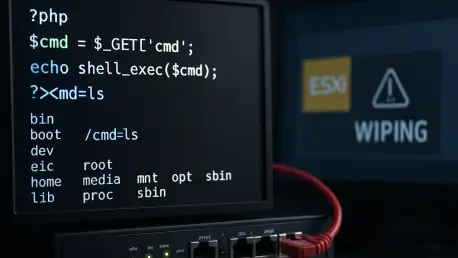

Vulnerability scanners often struggle to identify flaws in embedded appliance firmware, leaving many organizations unaware of their exposure to PHP2Shell vulnerabilities. The discovery of a complex attack chain involving Check Point Security Gateways demonstrates how quickly a vulnerability in a common runtime can escalate into a catastrophic network-wide event. By linking PHP2Shell remote code execution flaws with a local privilege escalation bug in the Gaia operating system, threat actors successfully moved from an external web-facing portal to the heart of the internal virtualization layer. This campaign, which reached its peak in November 2026, focused on the deployment of a destructive wiper known as destroy_v6, which systematically targeted VMware ESXi hosts to ensure maximum operational disruption. Unlike traditional ransomware campaigns that seek financial gain through data encryption and negotiation, this series of attacks appeared purely motivated by destruction, leaving organizations with little recourse other than a complete restoration from offline backups. The speed with which the vulnerability was weaponized after the initial PHP security fixes were released highlights the critical importance of rapid patch management for perimeter devices that maintain high levels of trust within the corporate network architecture.
The technical sophistication of the PHP2Shell chain illustrates a broader shift in the threat landscape, where attackers are increasingly targeting security appliances themselves to bypass traditional endpoint protections. Because these appliances often run specialized versions of Linux with embedded components like PHP, they occupy a blind spot for many security teams who rely on standard agent-based monitoring. The recent campaign targeted the Mobile Access portal—a common feature used by remote workers to gain secure entry into corporate resources—turning a tool designed for protection into a gateway for lateral movement. The transition from an unauthenticated web request to a root-level system takeover was achieved through a secondary exploit in the Gaia OS CLI, allowing attackers to bypass restrictive shells and gain full control over the underlying hardware. This sequence of events has forced a re-evaluation of how organizations manage the security lifecycle of their firewall and gateway infrastructure, particularly when those devices are responsible for brokering connections to sensitive backend systems like hypervisors.
1. Detailed Information That Check Point Confirmed Regarding the Comprehensive Breakdown of the Recent Cyber Attack
Check Point Research published an extensive technical analysis on Nov. 12, 2026, detailing how attackers were actively chaining the PHP2Shell vulnerabilities with local bugs to compromise corporate gateways. The investigation revealed that the first signs of this activity appeared on Oct. 30, roughly nine days after the initial PHP patches were made public, suggesting that threat actors were monitoring upstream development closely to identify exploitable targets. The campaign specifically focused on unpatched Security Gateways where the Mobile Access portal was reachable from the public internet, a configuration that is unfortunately common for organizations supporting a hybrid workforce. According to the research, the attackers did not stop at the perimeter; they used the compromised gateways as a staging ground to launch deeper attacks into the private network, eventually reaching the virtualization infrastructure. The confirmation of these attacks sent shockwaves through the cybersecurity community, as it demonstrated that even the most robust perimeter defenses could be circumvented if they contained outdated application-level components.
The security advisory released alongside the research report listed a wide range of affected software versions, including Security Gateway releases from R80 through R82.20 and several branches of the Spark Firewall line. This broad scope indicates that the vulnerability was not confined to a single legacy release but was present across the majority of the vendor’s active product portfolio. Check Point urged all administrators to apply the November Jumbo Hotfix immediately, prioritizing internet-facing systems that had not yet been shielded by interim IPS protections. The documentation provided a clear roadmap of the intrusion, starting from the initial unauthenticated remote code execution and ending with the execution of a wiper tool that targeted VMware ESXi hosts. While the research did not provide a specific victim count, the widespread nature of the attempts suggested that the attackers were using automated scanning to identify and exploit any vulnerable portals they could find. This proactive disclosure by the vendor was a necessary step in curbing the spread of the infection, providing the indicators of compromise required for security teams to begin their own internal hunting operations.
2. Technical Mechanics: How PHP2Shell Functions
The vulnerabilities known as PHP2Shell consist of two distinct remote code execution flaws, tracked as CVE-2026-109618 and CVE-2026-109619, which both carry a critical CVSS score of 9.2. The first of these vulnerabilities, CVE-2026-109618, is a memory corruption issue that occurs when the PHP interpreter experiences an out-of-memory condition during request processing. In a typical scenario, if a script exhausts available memory, the interpreter should shut down gracefully; however, this flaw allows for an interruption during the initialization of internal request data. If an attacker can carefully shape the server’s memory state, they can force the cleanup routine to treat uninitialized or partially built data as valid pointers, leading to a redirection of the execution flow. This type of memory corruption is notoriously difficult to detect through standard fuzzing or code review, as it relies on a specific sequence of resource exhaustion that may not be apparent during normal operation. The ability to execute code without authentication makes this a primary target for threat actors looking to gain an initial foothold on a web-facing server.
The second vulnerability, CVE-2026-109619, involves a stale global state within the PHP runtime, particularly when deployed in a mod_php environment with specific configurations. This flaw is most potent when the server is configured to hide errors from the end user, which is a standard setting for production environments to prevent information disclosure. The vulnerability arises when the interpreter’s global state is not correctly reset between requests, allowing an attacker to inject malicious data that persists into subsequent execution cycles. Like its counterpart, this bug does not require valid credentials to exploit, meaning any external entity capable of sending a specially crafted HTTP request to the vulnerable portal can potentially trigger the exploit. The severity of these bugs is amplified by their presence in the underlying runtime used by the gateway’s management and access portals, effectively turning the security device’s own interface into a liability. Because the PHP runtime is integrated into the appliance firmware, the appliance vendor must deliver the fix, adding a layer of complexity to the remediation process for the end user.
3. The Chained Attack: From Portal to Hypervisor
The progression of the attack from a web-based portal to the core of a data center’s virtualization layer relies on the inherent trust placed in the security gateway. In most enterprise architectures, the gateway is one of the few devices permitted to communicate across multiple network segments, including the highly sensitive management networks where VMware ESXi hosts reside. Once the attackers successfully executed code via PHP2Shell, they found themselves in a low-privilege environment on the gateway, yet they did not remain there for long. They utilized a secondary vulnerability, CVE-2026-123039, which exists in the Gaia OS Dynamic CLI, to escalate their privileges to the root level. This local privilege escalation was a critical step in the chain, as it provided the attackers with the administrative rights needed to bypass the restricted shell and access the underlying operating system. With root access, the threat actors could manipulate system files, install persistent backdoors, and gain access to any credentials or SSH keys stored on the device for administrative purposes.
The final stage of the movement involved pivoting from the compromised gateway to a VMware ESXi host, typically using SSH. Because administrators often log in to firewalls and then jump to other infrastructure components, the gateway often contains the necessary network routes and sometimes the credentials required for this lateral move. The attackers exploited this connectivity to reach the hypervisor, which serves as the foundation for the organization’s virtual servers and data storage. By gaining access to the ESXi shell, the intruders were able to bypass the security controls of individual virtual machines and strike at the underlying infrastructure itself. This move from a perimeter appliance to a central virtualization host demonstrates a deep understanding of corporate network design, where the “hard shell, soft center” philosophy often leaves internal management services poorly defended against an actor who has already compromised a trusted edge device. The transition was seamless, turning a simple web exploit into a complete takeover of the organization’s compute resources in a matter of minutes.
4. Gateway Persistence: The TSGA and TSProxy Implants
To ensure that their access remained stable even if the initial vulnerability was patched or the device was rebooted, the attackers deployed a specialized backdoor known as TSGA. This malware is a persistent Linux-based implant designed to blend in with the legitimate processes of the Check Point Gaia operating system, making it difficult for an administrator to spot during a routine check. TSGA works in tandem with a shared library component called TSProxy, which is often dropped into the system directory as libcpfwcommon.so. This library provides the attackers with an encrypted SOCKS-style proxy capability, allowing them to tunnel additional malicious traffic through the gateway and into the internal network. The use of an encrypted proxy ensures that command-and-control communications are hidden from traditional network-based intrusion detection systems, as the traffic appears to be part of the normal operation of the gateway’s security services. By naming the malware components after legitimate system processes, the actors sought to evade detection by security teams who might only be looking for obvious anomalies.
Detailed reporting on the TSGA implant suggests that it was designed for longevity and stealth, listening on non-standard ports like TCP 11072 while also using Unix sockets for internal communication. The malware reportedly ran under names like CPconfigdaemon or slot_CPconfigdaemon, mimicking the naming conventions used by official Check Point services. This level of camouflage is a hallmark of sophisticated threat actors who understand the environment they are targeting and want to avoid triggering alarms during the post-exploitation phase. TSProxy acts as a traffic multiplexer, allowing attackers to maintain multiple simultaneous connections to different parts of the internal network while appearing only as a single established session on the gateway itself. This persistence mechanism allowed the attackers to maintain their grip on the network long enough to identify the ESXi hosts and prepare for the final destructive phase of the operation. Without a thorough forensic examination of the gateway’s file system and running processes, many organizations would have no way of knowing that their perimeter had been permanently compromised.
5. Destructive Payload: The destroy_v6 ESXi Wiper
The most alarming aspect of this campaign was the deployment of the destroy_v6 wiper, a tool designed solely for the purpose of data destruction on VMware ESXi hosts. Once attackers gained SSH access to the hypervisor, they executed the wiper, which systematically began deleting files and directories across the target system. Unlike ransomware, which typically encrypts data and leaves a ransom note with instructions for payment, the destroy_v6 tool was built to ensure that the data was unrecoverable. Some reports suggest that the wiper may have even overwritten files with zeros before deletion, a technique intended to thwart forensic recovery efforts. The impact of such a tool on an ESXi host is devastating, as it can delete the virtual disk files for every server running on that host, effectively wiping out an organization’s entire digital infrastructure in one fell swoop. The use of a wiper signifies a shift in intent from financial gain to pure sabotage, where the goal is to cause maximum downtime and data loss for the victim organization.
During the destructive process, the attackers left behind text files named DREAM_ANNEXATION.txt, which contained politically themed messages. These notes served as a final signature of the attack, though their presence does not necessarily point to a specific political group, as they could be used as a false flag to misdirect attribution efforts. The choice of the ESXi host as a target for destruction was strategic; by destroying the hypervisor, the attackers could achieve a level of disruption that would be impossible to reach by targeting individual workstations or servers. Restoring an entire virtualization environment from backups is a time-consuming and complex process, often taking days or even weeks to fully complete, depending on the volume of data and the speed of the recovery systems. This final stage of the PHP2Shell chain serves as a stark reminder of the potential consequences of perimeter vulnerabilities, where a flaw in a remote access portal can lead directly to the total loss of an organization’s most critical data assets.
6. Exploitation Timeline: From Patch to Destruction
The timeline of the PHP2Shell exploitation provides a clear view of how quickly a disclosed vulnerability can be turned into an active threat. On Oct. 21, 2026, the PHP development team released patched versions of the runtime to address critical RCE flaws, while Check Point simultaneously activated IPS protections for its customers. Despite these early warnings and available protections, the window for exploitation remained open for those who did not apply the necessary updates immediately. By Oct. 22, research indicated that approximately 10% of organizations worldwide were already seeing attempts to exploit these vulnerabilities, demonstrating the massive scale of scanning operations conducted by threat actors. These early attempts likely focused on reconnaissance and identifying vulnerable targets before the full attack chain was ready for deployment. The speed at which these actors moved from a public announcement to large-scale scanning is a testament to the efficiency of the modern cybercrime ecosystem.
The first confirmed breaches of unpatched gateways occurred on Oct. 30, only nine days after the initial disclosure, representing a critical window during which organizations were most vulnerable while many were still testing patches or unaware their systems were affected. The full extent of the attack chain, including lateral movement to ESXi and the use of the destroy_v6 wiper, was not publicly detailed until Check Point Research released its report on Nov. 12. This suggests that the attackers were able to operate within compromised networks for nearly two weeks before the full scope of their activity was understood. For many victims, the realization that they were compromised only came when their servers went offline due to the wiper’s activity. This rapid progression from patch release to data destruction underscores the need for a more aggressive approach to security updates, where critical perimeter vulnerabilities are addressed within hours rather than weeks.
7. Identifying the Potential Security Risks Associated with Exposed Software Releases and Development Builds
Understanding who is at risk requires a detailed look at the software versions and configurations that are vulnerable to the PHP2Shell chain. The primary risk group consists of organizations running Check Point Security Gateways with an active Mobile Access portal that is reachable from the internet. The affected versions cover a significant portion of the vendor’s current installations, including the main R80 through R82.20 releases and several specialized Spark Firewall branches. This widespread exposure is due to the fact that these appliances use the vulnerable PHP runtime to power their web-based portals and management interfaces. Because the PHP runtime is a deeply embedded component of the gateway’s firmware, users cannot simply update the PHP package themselves as they might on a standard web server. They are entirely dependent on the vendor to release a firmware update or a jumbo hotfix that includes the patched version of the runtime, which creates a natural delay in the remediation process.
Beyond the specific gateway releases, the risk also extends to any other products or systems running the affected PHP builds in a mod_php configuration. The vulnerable range includes several versions within the PHP 8.2, 8.3, 8.4, and 8.5 branches, particularly those built for AMD64 and ARM64 architectures. While the Check Point campaign is the most prominent example of this exploitation, any internet-facing application using these specific PHP versions could be a target for the same RCE techniques. For the gateways, the combination of the PHP flaw and the Gaia OS privilege escalation bug creates a uniquely dangerous situation where the entire device can be taken over. Administrators must conduct a thorough inventory of their perimeter devices to determine which ones are running the affected software and have the Mobile Access portal enabled. Identifying these systems is the first step in a successful defense strategy, allowing teams to prioritize their patching efforts and implement additional monitoring for those devices that cannot be updated immediately.
8. Comprehensive Remediation Steps: Implementing Patch Management and Proactive Threat Hunting Strategies to Secure Infrastructure
The first and most important step for any organization running affected Check Point infrastructure is the immediate application of the November Jumbo Hotfix. This update contains the necessary patches for the PHP runtime as well as fixes for the Gaia OS privilege escalation vulnerability, effectively breaking the attack chain. Security teams should prioritize gateways with Mobile Access portals exposed to the internet, as these are the most likely targets for automated scanning and exploitation. In addition to patching, it is essential to verify that the vendor’s IPS protections for CVE-2026-109618 and CVE-2026-109619 are active and correctly configured to block malicious requests. While IPS can provide an important layer of defense, it should not be viewed as a replacement for actual software patches, as attackers may find ways to bypass signature-based detections through obfuscation or other techniques.
Beyond the initial patching, organizations should conduct a proactive hunt for indicators of compromise on their gateways and hypervisors. This includes searching for the TSGA and TSProxy implants by looking for processes named CPconfigdaemon or checking for the presence of the libcpfwcommon.so file in the system libraries. Administrators should also scan for unauthorized listeners on TCP port 11072 and review the gateway’s logs for any unusual SSH activity directed at internal ESXi hosts. If a compromise is suspected, it is critical to assume that all credentials and SSH keys stored on the gateway have been stolen. This requires a full rotation of administrative passwords and the generation of new SSH keys for all management services. Finally, the security of the ESXi hosts themselves must be reinforced by disabling SSH where it is not needed and ensuring that the management interface is not reachable from the gateway or other perimeter segments. These combined actions form a comprehensive defense-in-depth strategy that can protect the organization from the current campaign and future variants of the attack.
9. Business Implications: Examining the Critical Correlation Between Stakeholder Trust and Vulnerability Patch Latency
The PHP2Shell campaign has significant implications for the business relationship between security vendors and their customers, particularly regarding the speed of patch delivery. When a critical vulnerability is discovered in an open-source component like PHP, there is a natural delay as appliance vendors integrate the fix into their own firmware and conduct regression testing. However, in an era where attackers can operationalize an exploit in less than ten days, a multi-week delay in shipping a security update is increasingly unacceptable to enterprise customers. This incident may prompt procurement teams to include specific requirements for patch latency in their contracts, demanding that critical upstream fixes be delivered to the appliance within a certain number of days. The business impact of a perimeter breach that leads to a hypervisor wipe is so severe that organizations are no longer willing to wait for the standard monthly update cycle for critical security issues.
Furthermore, this event challenges the traditional trust model where the security gateway is seen as the primary defender of the network. If the gateway itself is the source of the breach and the subsequent destruction of data, the value proposition of the appliance is called into question. Organizations may respond by accelerating their move toward zero-trust architectures, where no device is implicitly trusted regardless of its position on the network. In such a model, even a compromised gateway would not have the permissions needed to reach the ESXi management interface without additional layers of authentication and authorization. This shift would reduce the impact of a perimeter breach and prevent the kind of lateral movement seen in the PHP2Shell campaign. For vendors, the takeaway is clear: the security of the underlying platform is just as important as the features it provides, and the ability to respond rapidly to emerging threats is a key differentiator in a crowded and highly competitive market.
10. Industry Response: A Comprehensive Examination of the Strategic Methods That Other Technology Vendors Implemented to Effectively Manage and Mitigate Potential Risks
The PHP2Shell vulnerabilities were not unique to Check Point, and the industry response from other major security vendors provides an interesting point of comparison. Palo Alto Networks, for instance, released its own security advisory on Oct. 21, the same day the PHP patches were announced, detailing the impact on its products. While some of its systems were found to be vulnerable to the PHP bugs, there have been no public reports of a chained attack resulting in a hypervisor wipe comparable to what was seen with Check Point. This may be due to differences in the underlying operating system architecture or the way the PHP runtime is utilized within their respective portals. The speed with which Palo Alto and other vendors communicated with their customers was a critical factor in managing the risk, allowing administrators to make informed decisions about their patching priorities before active exploitation began on a large scale.
Broadcom, which now manages the VMware portfolio, also released an advisory concerning the PHP vulnerabilities within its Tanzu components. Importantly, the company clarified that the ESXi hypervisor itself was not vulnerable to the PHP2Shell flaws, as it does not rely on the affected PHP builds for its core functions. This distinction was vital for defenders, as it helped them understand that the threat to their virtualization environment was coming from the network and not from a flaw in the hypervisor code itself. The variation in vendor responses highlights the complexity of managing a vulnerability that exists in a widely used third-party runtime. Each vendor must assess the risk to its unique implementation and provide clear guidance to its users. For end users, this requires monitoring multiple advisory channels and understanding how each vendor’s product fits into the overall security posture of the organization. The Check Point incident serves as a case study in how a specific combination of vulnerabilities and network architecture can create a perfect storm for a highly destructive attack.
11. Historical Context: The Growing Threat to the Perimeter
The targeting of perimeter devices like firewalls and VPN gateways is part of a long-standing trend in cyberespionage and cybercrime. These devices are attractive to attackers because they sit at the edge of the network, remain constantly active, and often lack the sophisticated endpoint detection and response tools common on servers and workstations. Historically, threat actors have exploited vulnerabilities in these systems to gain a persistent foothold that is difficult to remove, as even a full wipe of the internal network may not affect the compromised gateway. In recent years, we have seen a series of high-profile zero-day exploits targeting various perimeter vendors, often attributed to state-sponsored actors looking for long-term access to sensitive networks. The PHP2Shell campaign follows this pattern but adds a new layer of aggression by incorporating a destructive wiper into the final stage of the attack, moving beyond simple surveillance.
The evolution of these attacks suggests that the perimeter is no longer just a barrier to be bypassed but a platform to be weaponized. By taking over the gateway, an attacker gains access to a wealth of information, including network topologies, user credentials, and encrypted traffic. The transition to destructive payloads like destroy_v6 represents an escalation in the stakes for perimeter security, where a single unpatched portal can lead to the total loss of the data center. This history of edge-device exploitation underscores the necessity of moving away from a perimeter-centric security model. As attackers become more proficient at finding and chaining vulnerabilities in these systems, the traditional “castle and moat” defense becomes increasingly fragile. The lessons learned from the Check Point campaign will likely influence network security strategies for years to come, as organizations seek new ways to protect their core assets from a compromised and weaponized perimeter.
12. Attribution Analysis: The Search for a Culprit
Attributing the PHP2Shell campaign to a specific threat actor remains a challenge, as the evidence in the public record is currently limited to technical indicators and malware samples. Some analysts have noted a potential link between the TSGA and TSProxy implants and a malware framework known as PhiliKit, which has been associated with the UNC5221 cluster. This group has a history of targeting edge devices and using them for both espionage and disruptive operations. However, code overlap is not a definitive indicator of attribution, as malware frameworks can be shared, stolen, or sold between different groups in the underground market. The presence of politically themed DREAM_ANNEXATION.txt notes also complicates the picture, as these could be used as a distraction or a way to frame a particular group or nation-state. Without more direct evidence from command-and-control infrastructure or specialized intelligence, any attribution remains speculative.
What is clear from the analysis of the attack is that the operators are highly skilled and possess a deep understanding of enterprise network environments. The ability to chain three separate vulnerabilities into a seamless attack that culminates in a hypervisor wipe requires a level of planning and execution typical of sophisticated state-sponsored or high-end criminal actors. These groups often spend significant time conducting reconnaissance and developing specialized tools for their targets, ensuring they can move quickly once a new vulnerability like PHP2Shell becomes available. For defenders, the identity of the attacker is often less important than the techniques they use, as mitigations remain the same regardless of who is behind the keyboard. However, understanding the likely profile of the attacker can help organizations better assess their own risk and tailor their threat models accordingly. As more data becomes available from incident responders and government agencies, a clearer picture of the actors behind this campaign may eventually emerge.
13. Future Outlook: A Comprehensive Assessment of Five Major Strategic Predictions for the Coming Months of this Year
In the wake of the PHP2Shell Check Point campaign, several trends are likely to emerge in the threat landscape over the next ninety days. First, we can expect to see more vendors of embedded systems and appliances publish advisories as they discover their own exposure to the PHP2Shell vulnerabilities. The widespread use of PHP in web management interfaces means that many other products are likely sitting on the same ticking time bomb. Second, the indicators of compromise for this campaign will likely expand as more organizations conduct forensic investigations and share their findings. We may see new versions of the TSGA backdoor or different wiper payloads as the attackers adapt to the increased scrutiny. This cat-and-mouse game will continue as long as there are unpatched systems available for exploitation.
Third, the insurance industry is likely to take a much closer look at how organizations manage their perimeter and virtualization security. In the future, cyber insurance policies may mandate that ESXi management interfaces be completely isolated from any gateway or firewall that has a public-facing portal. This could lead to a significant shift in how networks are designed and audited. Fourth, the debate over attribution will likely continue without a definitive conclusion, as the actors behind the campaign use increasingly sophisticated methods to hide their tracks. Finally, we may see a proliferation of “gateway-to-wiper” attacks as other threat groups realize the effectiveness of this tactic for causing maximum disruption. The blueprint provided by the PHP2Shell chain is too effective to be ignored by other actors looking to strike at the heart of corporate infrastructure. Organizations must remain vigilant and proactive in their defense strategies to stay ahead of these evolving threats.
14. Essential Information: Frequently Asked Questions Answered
What is PHP2Shell, and why is it so dangerous for organizations using Check Point gateways? PHP2Shell is the collective name for two critical remote code execution vulnerabilities in the PHP runtime that allow an unauthenticated attacker to execute malicious code on a vulnerable system. In the case of Check Point, these vulnerabilities were found in the software that powers the Mobile Access portal, providing an entry point for attackers to compromise the entire gateway. Once the gateway is compromised, attackers can use additional local bugs to gain root access and pivot to other sensitive areas of the network, such as the virtualization layer. The danger lies in the unauthenticated nature of the exploit and the high level of trust that the gateway holds within the corporate environment.
According to the official security advisory regarding which specific versions of Check Point hardware and software are affected by these vulnerabilities, the affected systems include Security Gateways running versions R80 through R82.20, as well as several models in the Spark Firewall line, including the R77.20.x, R80.20.x, R81.10.x, and R82.00.x branches. The risk is particularly high for any of these systems that have the Mobile Access portal enabled and accessible from the public internet. Organizations should check their current firmware versions and apply the November Jumbo Hotfix immediately to protect their systems. It is also important to remember that even if a system is not directly internet-facing, it could still be a target for lateral movement if an attacker gains access to another part of the network.
Determining whether an organization’s gateway has been compromised by this attack chain requires a combination of log analysis and a search for specific indicators of compromise on the device itself. Administrators should look for suspicious processes, such as CPconfigdaemon or slot_CPconfigdaemon, and check for the existence of the libcpfwcommon.so file in the system’s library directories. Additionally, monitoring for unauthorized network listeners on TCP port 11072 can help identify the presence of the TSGA backdoor. If a VMware ESXi host has been targeted, the presence of DREAM_ANNEXATION.txt files or the sudden loss of virtual machine data is a clear sign that the wiper stage has been reached. Because these implants are designed to be stealthy, a thorough forensic review is often necessary to confirm a breach.
In the aftermath of the attacks, the security community worked to document the full sequence of events that led to the hypervisor wipes. The campaign successfully demonstrated how a single unpatched component in a perimeter appliance could be used to bypass an organization’s entire security architecture. By the time the November Jumbo Hotfix was widely available, many organizations had already faced the devastating consequences of the destroy_v6 wiper, highlighting the critical need for speed in the vulnerability management process. The transition from initial access to full data destruction happened with a level of efficiency that caught many defenders off guard. As the industry looked back at the events of late 2026, the focus shifted toward building more resilient architectures that did not rely on the absolute security of any single device. The lessons learned during this period were instrumental in shaping the next generation of zero-trust and defense-in-depth strategies, ensuring that the same mistakes would not be repeated as new threats emerged.