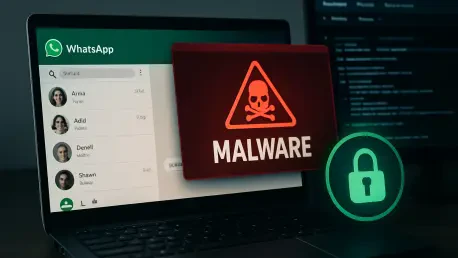

The familiar notification chime of a messaging app often signals a harmless update from a colleague, yet this very sense of professional intimacy is now being weaponized to bypass sophisticated corporate defenses. Receiving a routine invoice or a financial report from a long-time contact usually does not raise any red flags, but that simple file often serves as a gateway for a total system takeover. This campaign exploits the high level of trust inherent in direct messaging to bypass the skepticism users typically reserve for unsolicited emails.
By hijacking legitimate accounts, attackers turn a professional network into a delivery system for malicious scripts, making the threat feel personal and urgent. This shift requires a fundamental reevaluation of how digital trust is managed in a professional environment. Because the message arrives from a known sender, the recipient is far more likely to ignore standard security protocols, providing the perfect entry point for intrusive software.
The Hidden Trap Inside Your Trusted Contact List
The strategy relies heavily on the psychological comfort of familiarity. When a user receives a document from a compromised account within their own circle, the traditional defenses of skepticism and caution are often lowered. These malicious files frequently appear as billing statements or urgent account notices, creating a sense of professional obligation that encourages immediate execution.
Furthermore, the campaign utilizes a localized approach to increase its deceptive power. By employing filenames in the native language of the target region, the attackers make the malicious attachments blend seamlessly into the victim’s daily workflow. This level of customization ensures that the malware does not look like an external threat but rather a necessary part of the user’s ongoing business communications.
Why Messaging Platforms Are the New Frontier for Remote Access Trojans
As traditional email filters become more adept at catching phishing attempts, threat actors migrate toward messaging apps like WhatsApp to find a path of least resistance. This shift matters because desktop applications often lack the same level of rigorous attachment inspection found in enterprise email gateways. The relative novelty of using these platforms for file sharing in a corporate context means that many security frameworks have not yet adapted to the unique risks they present.
With significant activity detected across the globe—from the United Kingdom and Spain to India and Brazil—this campaign demonstrates how a localized approach to social engineering effectively compromises Windows environments on an international scale. The broad geographic reach highlights the scalability of the attack, as the software remains consistent while the delivery lures are tailored to fit various linguistic and professional contexts.
Breaking Down the Multi-Stage Attack Chain
The attack begins with the delivery of heavily obfuscated VBScript files that masquerade as benign documents. Once a user executes the file via WhatsApp Web or Desktop, the Windows Script Host is triggered to modify the Windows Registry and silently disable User Account Control protections. This manipulation is critical because it allows the malware to escalate privileges without ever alerting the user through a standard security prompt.
The most deceptive part of this process is the “living off the land” strategy, where the malware installs ManageEngine Endpoint Central, which is a legitimate IT management tool. By repurposing professional software, the attackers gain full administrative control over the machine without triggering standard antivirus alarms. This method effectively turns a trusted administrative utility into a back door for unauthorized remote access.
Intelligence Reports and Potential Attribution
Cybersecurity researchers identified several clues that point toward a sophisticated, well-organized operation. Code artifacts and infrastructure overlaps suggested a potential link to Chinese-speaking threat actors, specifically due to connections with IP addresses previously associated with malware families like ValleyRAT and Gh0st RAT. These connections indicate a level of technical continuity with established cyber-espionage operations.
The use of localized filenames in multiple languages further highlighted the calculated nature of this campaign, as attackers tailored their lures to fit the specific linguistic context of their victims. This attention to detail suggests a threat actor with the resources to conduct extensive reconnaissance and maintain a complex command-and-control infrastructure across multiple continents.
Essential Strategies to Secure Your Windows Environment
Protecting the environment required a shift in how digital files were handled, even when they arrived from a known sender. Experts concluded that the most effective defense involved verifying the legitimacy of a document through a secondary communication channel, such as a quick phone call, before it was opened. This simple step acted as a critical barrier against the exploitation of compromised accounts within a professional network.
It was also vital to remain skeptical of specific file extensions like .vbs, .js, or .exe, which were rarely used for legitimate document sharing in a professional context. Ensuring that security software remained up-to-date and configured to scan all incoming downloads provided a necessary final layer of defense. Organizations also discovered that implementing strict execution policies for scripting hosts helped neutralize the threat before the management software could be silently installed.