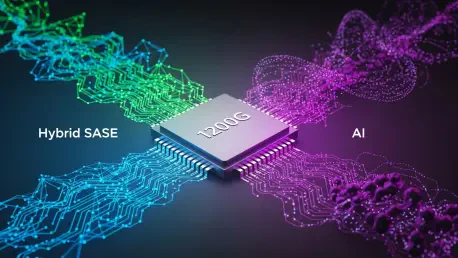

The rapid proliferation of sophisticated artificial intelligence and the decentralization of the corporate perimeter have created an unprecedented strain on modern enterprise network architectures. As organizations struggle to manage the massive influx of data generated by generative AI models and distributed workflows, the traditional methods of securing point-to-point connections have become increasingly obsolete. In response to these shifting dynamics, Fortinet has introduced the FortiGate 1200G series, a high-performance appliance designed to act as the primary bridge between on-premises security and cloud-delivered services. This launch represents a significant pivot toward a “Hybrid SASE” model, where the power of local hardware is combined with the agility of the cloud to provide a seamless security fabric. By integrating the FortiSASE Outpost capability, the 1200G allows businesses to maintain the performance levels required for real-time applications while leveraging the centralized management benefits of a cloud-native architecture, ensuring that protection remains robust across all points of access.
Hardware Acceleration: The Foundation of Performance
Custom ASIC Technology: Driving Efficiency
At the core of the FortiGate 1200G series lies Fortinet’s proprietary Application-Specific Integrated Circuit (ASIC) technology, which differentiates the platform from standard security solutions that rely on general-purpose processors. Unlike traditional central processing units that must juggle various operating system tasks alongside security inspection, these custom-built chips are engineered specifically to accelerate compute-intensive functions like Secure Sockets Layer (SSL) decryption and deep packet inspection. This hardware-level optimization is essential in an era where encrypted traffic accounts for the vast majority of network data, often causing significant performance degradation in software-only environments. By offloading these tasks to dedicated silicon, the 1200G maintains high throughput and low latency, which are critical for maintaining the responsiveness of internal business applications and preventing security from becoming a bottleneck to operational speed.
Furthermore, the focus on hardware acceleration addresses the specific needs of modern data centers that handle “east-west” traffic—the internal communication between servers that has skyrocketed with the rise of microservices and AI-driven internal processing. Without specialized hardware, inspecting this massive volume of internal data would require an impractical number of standard server racks, driving up energy costs and physical footprint. The FortiGate 1200G effectively condenses this processing power into a single appliance, offering a significantly higher “security compute rating” compared to industry averages. This efficiency not only lowers the total cost of ownership for enterprises but also provides a more sustainable path for scaling network defenses as data volumes continue to grow exponentially. This architectural approach ensures that as traffic patterns shift, the underlying hardware remains capable of defending the network without requiring constant, disruptive upgrades.
Scalable Connectivity: Preparing for High Bandwidth Demands
As network traffic continues to grow in both volume and complexity, the connectivity options provided by the FortiGate 1200G series are designed to meet the most demanding enterprise requirements. The appliance features a versatile array of high-speed ports, including 10G, 25G, and 100G interfaces, which provide the necessary pipes to transport large datasets across the corporate backbone. This flexibility is particularly important for organizations that are currently in the process of upgrading their core infrastructure to support faster networking standards. By offering 100G connectivity in a compact form factor, Fortinet enables businesses to future-proof their environments, ensuring that the firewall does not become a restrictive chokepoint as more devices and high-bandwidth AI applications are introduced into the digital ecosystem. This level of throughput is no longer a luxury but a necessity for maintaining a competitive edge in a data-centric market.
Beyond raw speed, the physical integrity and security of the hardware itself are paramount in a landscape where supply chain attacks and firmware vulnerabilities are on the rise. The 1200G series incorporates hardware-rooted security features that verify the integrity of the device from the moment it is powered on. By using a secure boot process and hardware-based credential storage, the appliance protects itself against unauthorized modifications and low-level exploits that could bypass traditional software defenses. This commitment to hardware-level resilience ensures that the platform remains a trusted anchor for the wider security architecture. As enterprises integrate more diverse technologies into their stacks, having a secure, high-performance foundation allows them to focus on innovation rather than worrying about the underlying stability and safety of their networking hardware.
Hybrid SASE: Integrating Cloud and On-Premises
FortiSASE Outpost: Redefining Local Control
The introduction of the FortiSASE Outpost capability within the FortiGate 1200G marks a fundamental change in how Secure Access Service Edge (SASE) is deployed within the enterprise. Historically, SASE has been viewed primarily as a cloud-only architecture, where all traffic is backhauled to a vendor’s cloud-based Point of Presence (POP) for inspection. However, this model can introduce unwanted latency and high data transfer costs, particularly for branch offices or manufacturing sites that require immediate processing of local data. The FortiSASE Outpost transforms the physical FortiGate appliance into a local SASE POP, allowing for high-performance security enforcement to happen directly on-site while still being managed through the central cloud-based SASE console. This hybrid approach provides the best of both worlds: the localized speed of a hardware firewall and the simplified, global management typical of cloud-delivered security.
This local enforcement model is especially beneficial for organizations that utilize bandwidth-heavy applications such as high-resolution video surveillance or real-time industrial automation. By processing this traffic locally on the 1200G, enterprises avoid the “hairpinning” effect, where data must travel to a distant cloud data center and back before reaching its final destination. This reduction in latency is vital for maintaining the performance of time-sensitive services and enhancing the overall user experience for employees, regardless of their location. Moreover, the Outpost capability ensures that if the primary internet connection to the cloud management plane is interrupted, the local security policies remain in effect, providing uninterrupted protection for the local network. This level of autonomy is a key requirement for mission-critical environments where even a few minutes of downtime or unprotected traffic can lead to significant business risks.
Data Sovereignty: Navigating Regulatory Compliance
In a global business environment characterized by increasingly stringent data protection regulations, the ability to control exactly where security logs and sensitive information are processed has become a major concern for legal and IT teams. Many jurisdictions now require that certain types of data remain within specific geographic borders, a requirement that can be difficult to meet with standard cloud-only SASE solutions. The FortiGate 1200G and its Outpost functionality address this challenge by allowing organizations to keep data inspection and logging on-premises within their own controlled environment. This provides a clear path to compliance with regional laws like GDPR or other localized data residency requirements, as sensitive information never needs to leave the corporate perimeter to be secured. This capability empowers enterprises to expand into new markets with confidence, knowing their security architecture can adapt to local legal landscapes.
Furthermore, the hybrid model offered by the 1200G series provides enhanced visibility into how data is handled across the entire organization. By utilizing a single operating system, FortiOS, across both the physical appliance and the cloud SASE service, security administrators can maintain a consistent set of policies and audit trails. This consistency is crucial during regulatory audits, as it allows for a unified view of the security posture without the need to reconcile data from multiple disparate systems. The ability to demonstrate that the same rigorous security standards are applied to remote workers, branch offices, and headquarters—while respecting local data sovereignty—is a powerful advantage. This unified approach not only simplifies the compliance process but also strengthens the overall security posture by eliminating the “shadow IT” and policy gaps that often emerge when managing a fragmented mix of on-premises and cloud-only security tools.
Operational Security: Managing the AI Era
Unified Management: Streamlining Security Policies
One of the most significant challenges facing modern IT departments is the phenomenon of “tool sprawl,” where multiple standalone security products lead to a fragmented and difficult-to-manage environment. The FortiGate 1200G addresses this issue by running on FortiOS, a single, unified operating system that powers Fortinet’s entire security fabric. This unification allows security teams to manage their firewalls, SASE points, and AI-driven analytics from a “single pane of glass” interface. When a security policy is updated at the headquarters, those changes can be automatically pushed out to every FortiGate 1200G and cloud-based POP across the global network. This level of synchronization ensures that there are no weak links in the security chain, drastically reducing the window of opportunity for attackers who often exploit inconsistencies between different security configurations.
Beyond simplifying policy management, the unified nature of FortiOS enables deeper integration of AI-powered security services directly into the workflow. The 1200G leverages real-time threat intelligence from FortiGuard Labs, which uses advanced machine learning models to identify and block emerging threats in seconds. Because the entire ecosystem shares the same intelligence, a threat detected at a remote branch office is immediately recognized and blocked across the entire enterprise network. This proactive defense mechanism is essential for staying ahead of automated attacks and zero-day vulnerabilities that move too quickly for manual intervention. By automating the detection and response cycle, organizations can free up their highly skilled security personnel to focus on strategic initiatives rather than getting bogged down in the minutiae of repetitive manual tasks and alert fatigue.
Future Perspectives: Transitioning to Converged Architectures
The release of the FortiGate 1200G underscored a fundamental transition toward the total convergence of networking and security functions. In the past, these two domains were often managed by separate teams with different priorities, leading to friction and delayed deployments. However, as the digital landscape became more complex, the necessity of an integrated approach became undeniable. The successful adoption of this platform demonstrated that modern enterprises prioritize solutions that offer both high-performance connectivity and rigorous security within a single, manageable framework. This shift allowed businesses to reduce their technical debt by replacing aging, siloed equipment with a unified platform that scaled effectively with their growth. Moving forward, the focus will likely remain on enhancing this synergy, ensuring that security is an inherent part of the network fabric rather than an external layer.
Strategic decisions regarding infrastructure investments were increasingly driven by the need for adaptability and long-term viability. Organizations that integrated the 1200G series into their roadmap were able to navigate the challenges of AI-driven traffic growth and decentralized workforces with greater agility. The move toward hybrid SASE models proved to be a practical solution for balancing the demands of speed, local control, and cloud-like simplicity. For leaders looking to optimize their security posture, the primary takeaway was the importance of choosing platforms that support a unified operating environment. By prioritizing hardware-accelerated performance and consistent management, enterprises successfully prepared themselves for a future where the boundary between the physical and digital perimeters continued to dissolve, ultimately leading to a more resilient and responsive digital infrastructure.