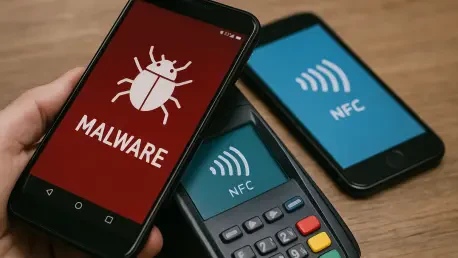

The rapid proliferation of contactless payment systems has inadvertently created a fertile environment for sophisticated cybercriminals who are now utilizing a dangerous new strain of Android malware known as WindRelay to hijack Near Field Communication signals for fraudulent transactions. This malicious software represents a major shift in the mobile threat landscape because it does not merely aim to scrape static card numbers or capture keystrokes. Instead, it functions as a highly efficient communication conduit that allows an attacker to proxy the physical interaction between a payment terminal and a legitimate user’s device in real-time. By exploiting the low-latency capabilities of modern 5G networks, the malware transmits NFC data packets across vast distances, enabling a secondary device controlled by the criminal to mimic the victim’s phone at a point-of-sale terminal. This evolution in digital pickpocketing demonstrates a profound understanding of the protocols that underpin modern banking.
Technical Architecture: The Mechanics of Remote Signal Hijacking
To initiate a successful relay attack, the WindRelay software typically gains access to a target Android device through social engineering tactics or compromised third-party application repositories that mimic legitimate utility tools. Once installed, the malware requests extensive permissions to access the NFC hardware and background data services, allowing it to remain dormant until a payment event is triggered or an attacker initiates a remote connection. When the victim’s phone is brought near a payment source or even while it sits in a pocket, the malware captures the Application Protocol Data Unit packets that are exchanged during a standard transaction handshake. These packets are not processed locally; instead, they are immediately encapsulated and forwarded to a command-and-control server that acts as a low-latency bridge between the victim and the attacker. The speed of this transmission is critical, as payment terminals usually have strict timeout thresholds.
The true ingenuity of WindRelay lies in its ability to bypass traditional Host Card Emulation security boundaries by intercepting the communication between the secure element and the Android operating system. Unlike previous iterations of mobile banking trojans that relied on overlay screens to steal credentials, this malware operates at a lower level of the stack, making it invisible to the average user and difficult for standard antivirus software to detect. The attacker uses a dedicated device equipped with a specialized emulator app that receives the relayed NFC data from the server and broadcasts it as if it were the original card. This allows the criminal to bypass biometric authentication requirements in some scenarios, particularly if the victim’s device is already unlocked or if the banking application’s security settings are configured for convenience. Consequently, the transaction appears entirely legitimate to the banking backend, as the cryptographic signatures remain valid throughout the entire proxy chain.
Strategic Mitigation: Defending the Contactless Ecosystem
Addressing the threat posed by WindRelay requires a multi-layered defensive strategy that moves beyond simple signature-based detection toward behavioral analysis and hardware-level integrity checks. Financial institutions and mobile operating system developers are currently evaluating the implementation of stricter latency monitoring protocols that can identify the millisecond delays inherent in a relay attack. By measuring the round-trip time of NFC handshakes with microsecond precision, payment terminals could potentially flag transactions that show signs of being proxied through a remote server. Furthermore, the integration of mandatory biometric re-authentication for every NFC transaction, regardless of the amount or the device’s lock state, would significantly hamper the effectiveness of silent relay exploits. These measures, combined with enhanced geofencing techniques that compare locations, provide a robust barrier against the current wave of contactless fraud.
Security researchers and industry leaders recognized that the only way to effectively neutralize the WindRelay threat was through the adoption of zero-trust communication models for all mobile hardware interactions. Developers successfully implemented advanced attestation APIs that verified the physical presence of the device relative to the merchant’s terminal before any financial data was allowed to leave the secure enclave. Users were encouraged to transition toward hardware-backed multi-factor authentication methods that required a physical gesture, such as a double-tap or a specific biometric sweep, to authorize the activation of the NFC controller. Additionally, the broader banking community established a unified reporting system that tracked the signature patterns of relay servers, allowing network providers to block malicious traffic at the infrastructure level. These proactive steps ensured that the convenience of contactless payments did not come at the expense of safety.