
The standard assumption that a computer disconnected from any external network remains fundamentally unreachable has been shattered by a sophisticated new method of data exfiltration. Historically, air-gapping was considered the final line of defense for the most sensitive systems, including those controlling national energy grids or classified military archives. However, the introduction of the TrojPix attack by researchers at Shandong University and Quan Cheng Laboratory demonstrates that physical isolation is no longer a guaranteed safeguard against state-level or highly organized cyber threats. This method does not rely on traditional radio modules or internet connectivity but instead exploits the unavoidable electromagnetic emissions produced by standard High-Definition Multimedia Interface cables. By turning these ubiquitous video components into accidental transmitters, adversaries can bridge the gap between a locked-down room and an outside listener. This breakthrough represents a significant shift in the threat landscape, proving that even the most secure facilities must now account for the physics of their hardware.
Technical Foundations and Protocol Exploitation
Signal Generation: Blue Channel Manipulation
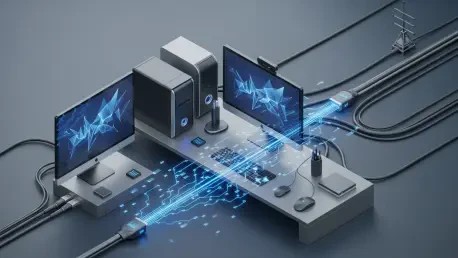
The core mechanism of TrojPix involves the intricate manipulation of Transition-Minimized Differential Signaling, the primary protocol used to send digital video data over modern digital cables. By precisely altering the least significant bit in specific color channels, most notably the blue channel, the malware can induce predictable fluctuations in the electromagnetic field surrounding the HDMI cable. These minute changes are essentially encoded data packets that propagate through the air as high-frequency radio signals. Unlike many other advanced exploits that require elevated administrative privileges or kernel-level access to sensitive hardware components, TrojPix operates entirely within the standard user-mode environment, making it significantly harder to detect through common system monitoring tools. Furthermore, it achieves an impressive data transfer rate of approximately 8.1 megabits per second. This speed is nearly thirty times faster than previous methods of electromagnetic exfiltration, allowing for the rapid removal of large files or live encryption keys from a supposedly secure machine.
Visual Stealth: Hiding Data Within Active Pixels
Maintaining the secrecy of the exfiltration process is critical for any long-term espionage operation, and the researchers behind this attack have developed two highly effective modes to achieve this goal. The first, known as “Fake Screen-Off” mode, convinces the user that the monitor is powered down while the cable continues to transmit a high-frequency stream of stolen data. The second approach, “Foreground Embedding,” integrates the malicious signal directly into the active display content while the computer is in use. To the human eye, these alterations are entirely imperceptible because the pixel shifts are far too subtle to be recognized by biological vision. To ensure the integrity of the stolen data at the receiving end, the system utilizes advanced signal processing techniques such as Pixel-to-Sample Mapping and matched-filter correlation. These methods allow the attacker to reconstruct the original information with near-perfect accuracy, even when the signal has been distorted by environmental noise or transmitted through physical obstacles like interior walls.
Impact Analysis and Practical Mitigation
Long Range Capture: Transmitting Through Concrete Walls
One of the most concerning aspects of this research is the sheer distance over which the leaked signal remains viable for interception by an outside adversary. Extensive field testing has revealed that a software-defined radio equipped with a directional antenna can successfully capture and decode the data from distances exceeding 200 meters. Perhaps more alarmingly, the electromagnetic leakage from the HDMI cable is powerful enough to penetrate thick concrete walls, which means an attacker does not even need to be in the same building as the target system. The study confirmed that this vulnerability is not limited to a single manufacturer; rather, it is a fundamental weakness across a wide spectrum of monitor brands and cable types currently used in professional environments. When error correction protocols are applied to the transmission, the accuracy rate of the recovered data approaches 100 percent. This high level of reliability transforms a standard piece of office equipment into a long-range espionage tool that bypasses traditional perimeter security.
Mitigation Strategies: Shifting Toward New Hardware Standards
Addressing the risks posed by TrojPix requires a fundamental shift in how security-conscious organizations manage their hardware deployments and electromagnetic signatures. While traditional methods such as physical shielding or the use of electronic jamming devices can provide some level of protection, they are often difficult to implement effectively and can be bypassed by sensitive receiving equipment. A more robust solution involves the complete transition to fiber-optic video interfaces, which transmit data using light rather than electrical signals and therefore do not produce the electromagnetic leakage exploited by this attack. Additionally, software-based defenses can be implemented to disrupt the exfiltration channel by introducing random noise into the pixel values, effectively masking the malicious signal among legitimate video data. Organizations handling classified or high-stakes financial information must recognize that the landscape of physical security has changed. Relying solely on the absence of a network connection is no longer sufficient for systems.
Future Resilience: Strengthening the Physical Layer
The discovery of the TrojPix vulnerability forced a radical rethinking of what it meant for a computer system to be truly isolated from external threats. Security professionals recognized that the physical properties of video transmission could be weaponized, leading to the adoption of more stringent hardware certification programs. Moving forward, the most effective defense strategies prioritized the replacement of copper-based HDMI cables with non-conductive optical alternatives in all high-security zones. Implementation of signal randomization software became a standard practice for protecting air-gapped workstations against pixel-based exfiltration. Experts also recommended the use of electromagnetic TEMPEST-rated enclosures for critical infrastructure components to minimize any unintended emissions. By addressing these physical-layer vulnerabilities, organizations were able to close the covert channels that once allowed silent data theft. The evolution of this threat served as a reminder that security is an ongoing process of neutralizing unintended consequences.