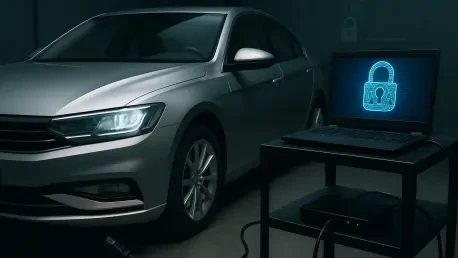

The modern passenger vehicle has transformed from a purely mechanical marvel of pistons and gears into a sophisticated, mobile data center that processes more information than the guidance computers of early lunar missions. While the sleek aesthetic of steel and chrome remains familiar, the hidden digital architecture within creates a complex web of vulnerabilities where every sensor and circuit serves as a potential doorway for remote interference. As society accelerates toward a landscape dominated by autonomous robotaxis, the priority of vehicle security has undergone a fundamental shift from merely protecting personal privacy to ensuring the physical safety of passengers on high-speed highways.
This digital metamorphosis brings unparalleled convenience, offering drivers real-time cloud diagnostics and seamless integration with mobile devices. However, this connectivity creates a permanent bridge for malicious actors who no longer need physical access to a car to compromise its integrity. The stakes are uniquely high in the automotive sector; a software glitch or a targeted intrusion does not just result in a lost document or a leaked password—it can fundamentally alter the kinetic behavior of a two-ton machine traveling at seventy miles per hour.
From Isolated Machines to Integrated Network Nodes: The Legacy of the Jeep Cherokee Breach
The automotive industry encountered its defining moment of realization years ago when security researchers successfully demonstrated total remote control over a Jeep Cherokee’s critical systems while it was cruising on a public road. By infiltrating the infotainment platform, the researchers bypassed internal firewalls to manipulate the steering, transmission, and even the climate control. This event shattered the long-standing industry assumption that vehicles were isolated mechanical units, proving instead that wireless connections could be weaponized by those with the right technical expertise.
Today, this landmark incident serves as the primary catalyst for contemporary defense strategies, illustrating why manufacturers can no longer treat cybersecurity as a peripheral feature or a post-production patch. It forced a paradigm shift where vehicles are now viewed as vital nodes within a sprawling, interconnected digital ecosystem. Engineers must now account for the fact that a vulnerability in a seemingly harmless component, like a digital radio or a tire pressure monitor, can potentially provide a lateral pathway to the engine control unit.
Navigating the Vulnerabilities of Millions of Lines of Code and Autonomous Decision-Making
Modern vehicles are built upon a fragmented global supply chain where various vendors contribute millions of lines of code to a single platform, creating a massive attack surface that is difficult to monitor comprehensively. As the industry moves deeper into the era of autonomous systems, the risk profile becomes increasingly lethal. When a computer, rather than a human, makes split-second decisions regarding emergency braking or lane changes, a hijacked system becomes a potential weapon. This complexity is further exacerbated by a persistent skills gap, as the market struggles to find professionals who can bridge the divide between heavy mechanical engineering and advanced software exploitation.
Furthermore, the constant link between mobile applications and vehicle cloud servers creates a persistent tether that extends the threat landscape far beyond the physical body of the car. Malicious actors can target the server-side infrastructure to send unauthorized commands to entire fleets of vehicles simultaneously. This transition to software-defined mobility means that a single flaw in a cloud API can have cascading effects, potentially disabling thousands of cars or allowing for widespread unauthorized tracking of users.
Regulatory Mandates and the Rise of Collaborative Defense Through Global Standards
The shift from voluntary safety guidelines to mandatory legal compliance has been solidified by the adoption of UN Regulation No. 155. This international mandate requires manufacturers in over sixty countries to provide documented proof of rigorous cybersecurity assessments throughout the entire fifteen-year lifecycle of a vehicle. Insights from the most recent industry summits in San Francisco suggest that the “white hat” hacking community, once viewed with suspicion, is now considered an essential partner. Collaborative environments like the Car Hacking Village have become instrumental in identifying zero-day vulnerabilities before they can be exploited by organized criminal syndicates.
Experts such as Kamel Ghali and Julio Padilha have emphasized that this culture of transparency is the only viable defense against sophisticated threats. By fostering a community where independent researchers can report bugs without fear of litigation, manufacturers have significantly shortened the time between the discovery of a flaw and the deployment of a security patch. This collective vigilance has moved the industry away from “security through obscurity” toward a robust model of verified resilience.
Future-Proofing the Fleet: Strategies for Long-Term Resilience Against Emerging AI and Quantum Threats
To safeguard the next generation of transport, manufacturers have begun implementing a multi-layered defense strategy that starts at the supply chain level and extends to post-quantum encryption. As threat actors started utilizing AI-driven tools to identify software bugs at unprecedented speeds, the automotive sector responded by integrating automated, AI-enhanced monitoring systems that detect and neutralize intrusions in real-time. Maintaining safety in this volatile environment required a proactive stance, where security was baked into the vehicle’s fundamental architecture from the earliest design phases rather than being added as an afterthought.
The industry moved toward a comprehensive framework where the integrity of every data packet was verified through hardware-based “roots of trust” within the vehicle’s onboard processors. Designers prioritized the isolation of safety-critical systems from entertainment features, ensuring that even a compromised dashboard could not influence the braking or steering mechanisms. This shift toward a “zero-trust” internal architecture represented a commitment to long-term reliability, ensuring that the fleet remained resilient against both current digital hazards and the unforeseen technical challenges of the coming decade.