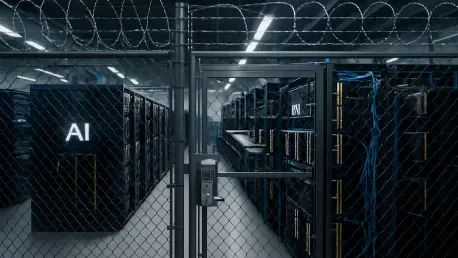

The transition of artificial intelligence from isolated laboratory experiments to the core of enterprise operations has created a new class of critical infrastructure, yet its foundational security remains dangerously misunderstood. What once were contained digital playgrounds for data scientists are rapidly evolving into industrial-scale “AI factories,” production environments designed for continuous model training, optimization, and inference. This shift elevates AI from a novel business tool to a mission-critical system, where failures carry immediate and severe consequences. As these systems become central to revenue, operations, and competitive strategy, organizations are discovering that conventional security measures, applied as an afterthought, are fundamentally incapable of protecting these complex and dynamic environments. The only viable path forward is to re-architect security as an intrinsic property of the AI infrastructure itself.
From Digital Playgrounds to Industrial Powerhouses: The Rise of the AI Factory
The maturation of AI from experimental models to full-scale production systems marks one of the most significant transformations in enterprise technology. These AI factories are not merely larger versions of their pilot-phase predecessors; they represent a fundamental shift in operational philosophy. They are purpose-built infrastructures, designed for the high-velocity lifecycle of AI, encompassing everything from massive data ingestion and perpetual model training to real-time inference serving millions of users. This industrialization turns AI into a core pillar of the business, directly influencing everything from customer experience to supply chain logistics.
This evolution brings with it a complete redefinition of risk. In the past, a flawed AI model might result in an inaccurate recommendation or a failed experiment. In an AI factory, a compromised system can lead to catastrophic service outages, widespread data breaches, and the erosion of customer trust on a massive scale. The system’s constant state of flux, with models being retrained and redeployed continuously, multiplies the opportunities for error and attack, making it a far more challenging environment to secure than traditional, static applications.
The New Frontier of Risk: Understanding the AI-Specific Attack Surface
The architecture of an AI factory creates a novel and dramatically expanded attack surface that traditional security paradigms fail to address. Vulnerabilities are no longer confined to the application layer but are woven throughout the entire AI lifecycle. During the training phase, vast pipelines of sensitive enterprise and customer data are exposed for extended periods, creating prime targets for data exfiltration and intellectual property theft. More insidiously, attackers can engage in model poisoning, subtly corrupting the training data to embed hidden backdoors or biases that remain dormant until triggered in production.
Once a model is operational, the risks shift to real-time inference. Adversaries can use prompt injection techniques to bypass safety controls and guardrails, forcing a model to generate harmful or unauthorized content. They can also deploy carefully crafted adversarial inputs—seemingly benign data that is engineered to cause misclassification or system failure. These AI-specific threats demonstrate that protecting the perimeter is insufficient; the integrity of the data, the model, and the inference process itself must be secured from within.
A Paradigm Shift in Infrastructure: Why AI Demands More Than the Cloud
While public cloud platforms have been instrumental in fueling AI experimentation, the rigorous demands of production-grade AI factories are driving a necessary evolution in infrastructure strategy. The need for persistent, high-performance access to accelerated computing resources, coupled with predictable low-latency performance for inference, challenges the elasticity-focused model of the cloud. Moreover, tightening regulations around data sovereignty and privacy require organizations, particularly in sectors like finance and healthcare, to maintain stringent control over where their data is stored and processed.
This trend is not an outright rejection of the cloud but rather a pragmatic move toward purpose-built on-premises or hybrid cloud deployments. These environments provide the granular control needed to enforce consistent security policies and meet strict compliance mandates across the entire AI stack. The core requirement is a unified operational plane that ensures security and governance are maintained with equal rigor, regardless of whether a workload is running in a public cloud or a private data center.
The Expanding Threat Vector: Trends and Projections for AI Security
As AI systems become more integrated into critical business functions, the sophistication and frequency of attacks targeting them are projected to increase significantly. Security analysts anticipate a surge in automated, AI-driven attacks designed to probe for weaknesses in other AI systems. This emerging landscape of machine-versus-machine conflict will require defensive systems that can operate at a speed and scale beyond human capability. The threat is no longer theoretical; it is an active and evolving reality that demands immediate attention from enterprise leaders.
Projections from 2026 through 2028 indicate a marked shift from opportunistic attacks to targeted campaigns aimed at high-value AI assets, such as proprietary models and sensitive training datasets. These campaigns will likely exploit the seams between different components of the AI stack—compute, networking, and storage—where security policies are often inconsistent. Without a holistic and integrated security architecture, organizations will find themselves perpetually reacting to breaches rather than proactively preventing them.
The Anatomy of an AI Breach: From Model Poisoning to Prompt Injection
A modern AI breach can unfold in ways that are nearly invisible to conventional security tools. An attack might begin with model poisoning, where an adversary introduces subtly altered data into a training set. This corrupted data could, for example, teach a financial fraud detection model to ignore a specific type of illicit transaction. The flaw remains dormant and undetectable through standard testing, only revealing itself after the model is deployed and the attacker exploits the embedded vulnerability for financial gain.
In another scenario, an attacker could target a customer-facing chatbot with prompt injection. By carefully crafting a query, they could trick the model into overriding its programmed instructions and revealing sensitive information, such as other users’ data or proprietary system details. These attacks do not trigger traditional alerts because they do not involve malware or network intrusion; instead, they manipulate the inherent logic of the AI model itself, turning its greatest strength—its flexibility—into a critical weakness.
The High Stakes of Scale: Quantifying the Financial and Reputational Risks
The consequences of a security failure within an AI factory extend far beyond immediate financial loss. While the costs associated with regulatory fines, service downtime, and intellectual property theft are substantial, the damage to an organization’s reputation and customer trust can be far more devastating and permanent. When an AI system that interacts with customers is compromised, it erodes the public’s confidence in the company’s ability to safeguard their data and operate responsibly.
Furthermore, a significant breach can halt an organization’s innovation pipeline, as resources are diverted from development to remediation. The competitive advantage gained through AI can evaporate overnight, replaced by a protracted period of crisis management and regulatory scrutiny. In this high-stakes environment, the cost of architecting security into the system from the beginning is trivial compared to the immense financial and reputational cost of a failure at scale.
The Peril of Patchwork Protection: Why ‘Bolted-On’ Security Fails at Scale
The conventional approach of layering security controls on top of a completed application is fundamentally incompatible with the dynamic and distributed nature of an AI factory. This “bolted-on” methodology results in a fragmented and fragile security posture, where different tools manage different parts of the stack in isolation. This creates a patchwork of protections riddled with gaps, inconsistencies, and blind spots, which sophisticated attackers are adept at exploiting.
At the scale of a production AI system, this fragmented approach is not just inefficient; it is actively dangerous. The lack of a unified view and consistent policy enforcement across the infrastructure means that security teams are often unable to correlate events or understand the full context of a potential threat. Consequently, risk accumulates silently within the seams of the system until it manifests as a catastrophic breach or a debilitating operational failure.
Uncovering the Blind Spots: Gaps in Siloed Security Tooling
Siloed security tools, each designed for a specific domain like identity management, network security, or workload protection, operate with a limited perspective. An identity tool might verify a user’s credentials for initial access, but it typically loses visibility once that user begins interacting with complex data pipelines and model training jobs. Similarly, a network security tool can monitor traffic between servers but often lacks the context to understand whether the behavior of a specific workload is normal or malicious.
These gaps between tools create dangerous blind spots. For instance, an attacker who has compromised a legitimate user’s credentials might be able to move laterally across the AI infrastructure, accessing sensitive data or manipulating models without triggering alarms from any single tool. The inability of these siloed systems to communicate and share context means that the organization lacks a holistic understanding of risk, leaving critical components of the AI factory exposed and unmonitored.
The High Cost of Fragmentation: Where Inconsistent Policies Create Vulnerabilities
When security policies are applied inconsistently across different environments, they create exploitable loopholes. An organization might have stringent data access controls for its on-premises data center but more permissive policies for its cloud-based development environment. An attacker could exploit this discrepancy by targeting the weaker environment to gain an initial foothold and then pivot to more critical systems.
This fragmentation is not only a security risk but also an operational bottleneck. Developers and data scientists are often forced to navigate a complex and contradictory set of security rules, which slows down innovation and incentivizes the creation of insecure workarounds. Ultimately, the high cost of fragmentation is measured in both increased vulnerability and decreased agility, undermining the very benefits that the AI factory was designed to deliver.
Navigating the Compliance Gauntlet: Governance and Data Sovereignty in the AI Era
The proliferation of AI has been met with a corresponding increase in regulatory scrutiny, creating a complex compliance landscape that organizations must navigate. Regulations concerning data privacy, such as GDPR and CCPA, impose strict requirements on how personal data is collected, processed, and stored. For AI factories that train models on vast datasets containing sensitive information, meeting these requirements is a non-negotiable prerequisite for legal operation.
Furthermore, the issue of data sovereignty is becoming increasingly critical, with many countries mandating that data generated within their borders must remain there. This has profound architectural implications, often precluding the use of a centralized, global cloud infrastructure. Organizations must instead design their AI factories to accommodate these geopolitical realities, building systems that can enforce data residency and governance policies with precision and verifiability.
Securing the Data Pipeline: Ensuring Privacy from Training to Inference
Protecting data throughout the AI lifecycle requires a security model that extends from the initial point of ingestion to the final inference request. During training, robust access controls and encryption are essential to prevent unauthorized access to sensitive datasets. Techniques like data anonymization and differential privacy can be employed to minimize exposure while preserving the statistical properties needed for effective model training.
During inference, the system must be designed to prevent the leakage of private information. This includes securing the data sent in user prompts as well as the responses generated by the model. A comprehensive approach involves end-to-end encryption, strict access controls for inference endpoints, and continuous monitoring to detect and block attempts to extract sensitive data. Securing the entire pipeline ensures that privacy is not just a policy but an enforced technical reality.
The Regulatory Impact on Architecture: Data Residency and Its Technical Demands
Data residency requirements fundamentally shape the architecture of an AI factory. To comply with laws that restrict cross-border data transfer, organizations must be able to deploy and manage AI workloads in specific geographic locations. This often necessitates a hybrid or multi-cloud strategy, where infrastructure is distributed across various regions to keep data close to its source.
This distributed architecture introduces significant technical challenges. It requires a unified management and security plane that can enforce consistent policies across disparate environments. Organizations need the ability to control data placement with granularity, ensuring that a model trained on European customer data, for example, runs on infrastructure located within the EU. Meeting these technical demands is essential for navigating the global regulatory gauntlet and avoiding costly compliance failures.
Blueprint for a Secure Future: The Strategic Shift to Integrated Systems
To overcome the limitations of fragmented security, organizations must make a strategic shift toward integrated systems where security is an engineered-in property, not a bolted-on feature. This approach treats the entire AI factory—from the physical compute and networking layers to the AI orchestration and data platforms—as a single, cohesive system. By designing security into the foundation, it becomes a systemic attribute that enhances reliability and accelerates innovation.
This blueprint for a secure future moves away from a collection of disparate tools toward a unified architecture. In such a system, identity, policy, and telemetry are woven into the fabric of the infrastructure, providing consistent visibility and control across all components. This integration eliminates the dangerous gaps and blind spots that characterize traditional security models, creating a resilient and trustworthy foundation for scaling AI.
Engineering Trust from the Ground Up: The Principles of Architected Security
Architected security is built on a set of core principles designed to establish and maintain trust throughout the AI lifecycle. The first principle is zero trust, which dictates that no user or workload should be trusted by default, regardless of its location. Access is granted based on verified identity and context, and it is strictly limited to the minimum necessary permissions. This approach drastically reduces the potential impact of a compromised account or system.
Another key principle is workload isolation, which ensures that different AI jobs, such as training runs for different models, are securely separated from one another. This prevents lateral movement by attackers and contains the blast radius of any potential breach. Combined with comprehensive, real-time telemetry that provides deep visibility into system behavior, these principles create a foundation where trust is not assumed but continuously verified.
The Unified Stack: Integrating Compute, Networking, and Security by Design
The ultimate expression of architected security is the unified stack, where compute, networking, and security are integrated by design. In this model, security policies are not just applied to the infrastructure; they are an integral part of how the infrastructure operates. For example, network segmentation policies are automatically enforced based on the identity of the AI workload, ensuring that only authorized communication is allowed.
This deep integration enables a level of automation and consistency that is impossible to achieve with a collection of separate products. When a new model is deployed, the necessary security controls are provisioned automatically as part of the same workflow. This not only improves security but also enhances operational efficiency, allowing teams to innovate faster and with greater confidence. Purpose-built solutions that offer this pre-validated integration provide a clear path for organizations to build secure and scalable AI factories.
Building the Resilient AI Enterprise: An Actionable Framework for Leaders
Leaders who successfully guided their organizations through the transition to AI factories recognized that this journey required a fundamental shift in mindset and metrics. They understood that operational success and security were inextricably linked, and that most production failures—from outages to compliance incidents—stemmed not from flawed models but from the fragmentation at the seams of the infrastructure. By focusing on building a resilient, integrated foundation, they positioned their enterprises to scale AI safely and sustainably. This proactive, architectural approach proved to be the defining factor that separated fleeting experimentation from a durable, transformative business capability.
Beyond Model Accuracy: Redefining Success with Security and Reliability Metrics
The traditional metrics for evaluating AI, such as model accuracy, were found to be insufficient for production environments. A successful AI factory was defined by a broader set of metrics that encompassed operational resilience and security. Key performance indicators included retraining reliability, optimization throughput, and inference latency under load. Most critically, success was measured by the ability to maintain a robust and verifiable security posture, demonstrating that the system could be trusted with the most sensitive data and critical business processes. This shift in perspective ensured that security and reliability were treated as first-class objectives, on par with model performance.
The Imperative for a Unified Foundation: Recommendations for Secure Scaling
The experience of these leading enterprises yielded a clear set of recommendations for any organization looking to scale its AI initiatives securely. The central imperative was the adoption of an architected solution that integrated security, networking, and AI operations into a single, cohesive system. This unified foundation provided the consistent visibility and control necessary to manage risk across the entire AI lifecycle. By choosing solutions that were engineered for security from the ground up, these organizations moved beyond the reactive, patchwork approach of the past and built the resilient infrastructure needed to turn AI into a lasting competitive advantage.