
The most dangerous threats to an organization are often not the ones breaking down the digital gates, but those who have already found the keys to the kingdom and are quietly rewriting the rules from within. In the sophisticated world of state-sponsored cyber-espionage, attackers are increasingly turning their attention away from noisy, brute-force attacks and toward the subtle manipulation of core administrative infrastructure. This shift in tactics represents a formidable challenge for defenders, as adversaries learn to weaponize the very tools designed to maintain network order and security, transforming trusted systems into conduits for espionage.
The New Espionage Battlefield: Active Directory as a Prime Target
State-sponsored cyber-espionage campaigns continue to escalate in frequency and sophistication, with government entities and critical infrastructure remaining the most coveted targets. These operations are not driven by financial gain but by strategic intelligence gathering, making them patient, persistent, and exceptionally well-resourced. The objective is rarely a quick smash-and-grab; instead, these actors seek long-term, undetected access to sensitive information, intellectual property, and political communications.
At the heart of nearly every enterprise network lies Active Directory (AD), the centralized directory service that manages user identities, access permissions, and security policies. Its foundational role makes it an unparalleled high-value target. For an attacker, compromising AD is the equivalent of seizing the network’s command center. Control over AD grants the ability to create rogue administrator accounts, modify security settings network-wide, and move laterally with impunity, effectively rendering the entire digital environment transparent and vulnerable.
A prime example of this modern threat is the advanced persistent threat (APT) group known as LongNosedGoblin. This moderately sophisticated, Chinese-aligned actor has demonstrated a profound understanding of how to subvert enterprise trust. By focusing its efforts on manipulating Active Directory, the group provides a compelling case study in how espionage tactics have evolved to exploit the administrative backbone of modern organizations, turning a tool of control into a weapon of infiltration.
Anatomy of an Attack: Unpacking the LongNosedGoblin Playbook
From Recon to Dominance: Abusing Group Policy for Stealthy Deployment
A defining trend in modern cyberattacks is the use of “living-off-the-land” techniques, where adversaries leverage legitimate, pre-installed system tools to execute their campaigns. This approach allows them to blend in with normal administrative traffic, making their malicious activities incredibly difficult to detect with traditional security solutions that are often tuned to spot foreign code, not the misuse of native utilities.
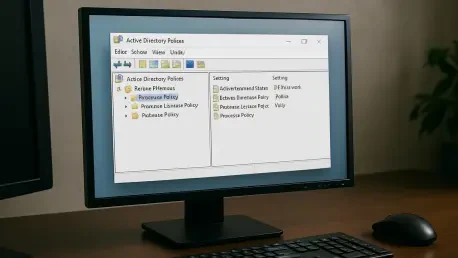
LongNosedGoblin has innovated in this space by weaponizing Active Directory’s Group Policy for malware distribution. Group Policy Objects (GPOs) are used by administrators to enforce security settings and deploy software across workstations and servers. The group’s ability to manipulate GPOs to push its malware implies a catastrophic security failure: they must have already obtained domain administrator credentials and gained control over a Domain Controller. This level of access allows them to deploy their malicious payloads with the full authority of the network itself.
The group’s attack methodology is multi-staged and highly methodical. It begins with the “NosyHistorian” reconnaissance tool, which scours a target’s browser history to identify high-value individuals. Once a worthy target is confirmed, the “NosyDoor” backdoor is deployed, often using the compromised Group Policy for distribution. This backdoor is particularly insidious, using legitimate cloud services like Microsoft OneDrive for its command-and-control communications, further camouflaging its presence within expected network traffic.
Campaign Footprints and Future Threats: Tracking the APT’s Expansion
Intelligence gathered since 2023 indicates LongNosedGoblin has been conducting a focused cyber-espionage campaign primarily targeting government organizations in Japan and other Southeast Asian nations. The group’s operations are highly selective, with evidence of fewer than a dozen confirmed victims, a hallmark of espionage-motivated actors who prioritize stealth and long-term access over widespread, noisy infections. This surgical precision suggests a clear and strategic intelligence-gathering objective.
The group’s custom C#/.NET toolkit is in continuous development, a clear indicator of their commitment and evolving capabilities. While their current footprint is limited, their novel techniques, particularly the abuse of Group Policy, present a significant future threat. As their methods are battle-tested and refined, their operational scope could easily expand, or their successful tactics could be emulated by other threat actors within the broader cyber-espionage landscape. The widespread use of their “NosyDownloader” tool in Southeast Asia in 2024 and an updated version deployed against the Japanese government later that year shows a clear pattern of iteration and operational escalation.
The Defender’s DilemmDetecting Malice in Administrative Noise
One of the most significant challenges for security operations teams is differentiating between legitimate administrative actions and malicious activity. An administrator modifying a GPO is a routine, necessary task in any large enterprise. When an attacker with domain administrator credentials performs the same action to deploy malware, the event logs look identical. This “administrative noise” provides perfect cover for threat actors like LongNosedGoblin, making detection a complex analytical challenge rather than a simple matter of spotting an anomaly.
The compromise of a Domain Controller and the domain administrator accounts that manage it is a worst-case scenario for any organization. At this point, the attacker holds the keys to every user account, server, and workstation on the network. They can exfiltrate data at will, deploy ransomware, or simply sit undetected for months or years, siphoning intelligence. The integrity of the entire IT environment is fundamentally broken.
Achieving this level of access is the culmination of an attacker’s campaign, not the beginning. It is often the result of preceding security failures, such as successful phishing attacks that harvest initial credentials, a failure to patch vulnerabilities that allow for privilege escalation, or inadequate monitoring of privileged account activity. The success of LongNosedGoblin’s GPO-based attacks is therefore not just a story about a clever technique but also a reflection of gaps in foundational security hygiene within their target networks.
Rethinking Security Posture: Policy, Compliance, and Hardening Active Directory
Numerous regulatory frameworks and security standards mandate that organizations implement robust controls to protect critical digital infrastructure, with Active Directory being a primary focus. These policies often require measures such as access control, audit logging, and configuration management to ensure the integrity of identity and authentication systems.
However, tactics like the abuse of Group Policy demonstrate how sophisticated adversaries can operate within the bounds of seemingly normal administrative behavior, bypassing many traditional security tools and satisfying surface-level compliance checks. This highlights a critical gap between being compliant and being secure. A security posture that relies solely on perimeter defenses and signature-based detection is ill-equipped to counter an attacker who has already gained privileged internal access and is using legitimate tools for malicious purposes.
Mitigating these advanced threats requires a shift in defensive strategy. The principle of least privilege must be rigorously enforced, ensuring that even administrator accounts have only the access required for their roles. Furthermore, organizations must implement granular monitoring and immediate alerting for any changes to GPOs and other critical objects within Active Directory. Hardening Domain Controllers by restricting access, removing unnecessary software, and closely monitoring all activity on these critical servers is no longer an option but a necessity for survival in the current threat environment.
Evolving Threats: What’s Next for State-Sponsored Infiltration?
The tactics employed by LongNosedGoblin offer a glimpse into the future of state-sponsored cyber-espionage. There is a clear and accelerating trend toward the use of native administrative tools and “living-off-the-land” techniques to achieve stealth and persistence. As defenders become better at detecting foreign malware, attackers will increasingly co-opt the trusted tools already present within their target environments.
Given its effectiveness, the innovative use of Group Policy for malware deployment and lateral movement has the potential to become a new standard in the playbooks of other threat groups, particularly those aligned with Chinese state interests. The security community should anticipate the proliferation of this and similar techniques that subvert core infrastructure components, turning elements of trust into vectors of attack.
The continued development of LongNosedGoblin’s malicious toolkit is another indicator of future operational intent. The existence of specialized tools like “NosyStealer” for data exfiltration and “NosyLogger” for keystroke logging demonstrates their capability to conduct a full spectrum of espionage activities once a foothold is established. This evolving arsenal suggests the group is a persistent, long-term threat that will continue to refine its tools and techniques.
Final Verdict: Fortifying Your Digital Fortress Against Invisible Intruders
The LongNosedGoblin campaign exemplified a new class of threat that subverted the foundational trust inherent in enterprise IT environments. The group’s innovative abuse of Active Directory Group Policy demonstrated how deeply-embedded administrative tools could be weaponized, allowing spies to operate undetected within the “noise” of legitimate network traffic.
This analysis ultimately underscored the necessity of a fundamental shift in security strategy. The findings pointed away from a singular focus on perimeter defense and toward a model prioritizing deep internal network visibility and a zero-trust mindset, where no activity, even that from a privileged account, was implicitly trusted.
The investigation into these tactics revealed clear, actionable imperatives for defense. Organizations recognized the critical need to implement enhanced, real-time logging for all GPO modifications, deploy sophisticated anomaly detection to flag unusual privileged account behavior, and enforce stringent, multi-layered access controls for the Domain Controllers that serve as the nerve center of the digital enterprise.