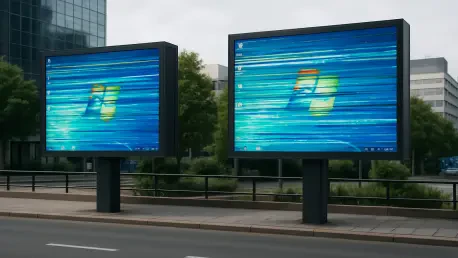

Commuters navigating the bustling corridors near London’s Stratford station recently encountered a jarring interruption to the polished stream of digital advertisements that usually dominates the skyline. Instead of a high-definition promotion for luxury goods or upcoming cinematic releases, a massive digital billboard displayed a blue-tinted Windows system dialogue asking whether the underlying PC should be made discoverable on the network. This specific technical failure, often colloquially referred to as a “bork,” highlighted an amusing yet frustrating irony: the software prompt was essentially asking for visibility while already being broadcast to thousands of passersby. The incident occurred in a high-traffic area adjacent to the Queen Elizabeth Olympic Park, serving as a reminder that even the most expensive advertising hardware remains entirely dependent on the stability of the software layer beneath it. While the hardware infrastructure in Stratford has undergone significant upgrades from 2026 to the present, the persistent appearance of decade-old user interface quirks suggests a stagnation in how these systems are actually managed and deployed.
The Structural Risks of Desktop Operating Systems
The reliance on general-purpose operating systems like Windows for public digital signage introduces a host of vulnerabilities that specialized platforms typically avoid. These large-scale screens are essentially high-performance monitors connected to standard desktop hardware, which often runs a full version of a consumer or enterprise OS. Consequently, these billboards are susceptible to the same interruptions that plague home computers, such as automatic update notifications, firewall prompts, and background system errors that can unexpectedly seize visual priority over the intended content. In the Stratford incident, the specific visual style of the network discovery prompt traced its lineage back to the Windows 8 era, which coincidentally launched during the same period as the 2012 London Olympics. This historical overlap underscores a deeper issue in the industry: the tendency to layer modern, expensive LED panels over legacy software environments that were never strictly designed for twenty-four-hour, unattended public operation. Using a comprehensive desktop environment to run a simple loop of video files is often viewed by technicians as an excessive solution that prioritizes convenience for administrators over the absolute reliability required for public-facing infrastructure.
Stakeholders within the digital-out-of-home advertising sector recognized that the path forward necessitated a move away from bloated software architectures. Engineering teams began prioritizing the adoption of lightweight, hardened kernels and purpose-built Linux distributions designed specifically for signage to eliminate the risk of intrusive desktop-level notifications. This transition involved stripping away non-essential system components, such as network discovery services and interactive dialogue managers, which previously served no purpose other than to create potential points of failure. Furthermore, the implementation of more robust remote monitoring tools allowed for the silent resolution of errors before they could manifest on the public display. By shifting the focus toward specialized environments, companies sought to preserve the professional integrity of their digital assets. These organizations ultimately determined that the high cost of public technical embarrassments outweighed the initial convenience of using familiar desktop software. This strategic pivot toward specialized operating environments ensured that the hardware legacy of the Olympic district finally matched the modern standards of software reliability expected by advertisers and the public alike.