
The global race to achieve artificial intelligence at a planetary scale has shifted from a battle of individual processor speeds to a desperate contest over how efficiently those processors can talk to one another. While the mainstream tech press remains fixated on the raw power of the latest Blackwell GPUs, the quiet architectural revolution is happening in the dark fibers connecting them. Nvidia has recently signaled the next phase of its dominance by injecting $4 billion into the optical networking sector, effectively transforming itself from a chipmaker into the primary architect of the AI nervous system.
This massive capital deployment serves as a definitive hedge against the physical limitations of current computing. As large language models transition toward trillion-parameter architectures, the sheer volume of data moving across clusters has reached a breaking point. By splitting this $4 billion investment equally between Coherent and Lumentum, Nvidia is not just buying components; it is ensuring that the light-based communication required for the next decade of AI growth remains under its strategic influence.
The Silicon Photonics Power Move: Beyond the GPU
When a company of this magnitude moves billions of dollars into the specialized field of photonics, it signals that the era of copper dominance is nearing its end. This strategic strike focuses on securing silicon photonics and advanced laser components, which are the essential building blocks for high-speed optical networking. While the public continues to focus on #00 and Blackwell sales, this move ensures that the “optical highways” required to link thousands of chips together at light speed remain wide open and proprietary.
This shift represents a departure from merely producing processing power to owning the connectivity layer that defines how clusters function. Without this vertical integration, even the most advanced GPUs would sit idle while waiting for data to travel across congested electronic pathways. By securing this supply, the company prevents a situation where hardware output outpaces the industry’s ability to actually utilize that power in a distributed environment.
Why the Networking Bottleneck Threatens the AI Revolution
Traditional copper-based networking is rapidly hitting its physical limits regarding heat dissipation and signal degradation over distance. As AI clusters expand to fill massive datacenters, the latency introduced by electrical resistance becomes a catastrophic barrier to performance. If the industry cannot solve the bandwidth wall, the evolution of next-generation LLMs will stall, regardless of how many chips are manufactured.
The “scale-out” requirements of modern training demand that data move between racks with zero friction. This is why the investment in laser sources and transceivers is so critical; it provides the reliable, high-volume supply of components necessary to bypass the limitations of traditional wiring. Without this transition to optical interconnects, the energy costs of moving data would eventually exceed the energy costs of the computation itself.
Strategic Integration: Securing the Optical Supply Chain
By locking in purchase commitments for transceivers and optical circuit switches, Nvidia has essentially cornered the market on critical hardware. This strategy builds upon the foundation laid by the 2020 Mellanox acquisition, further cementing a lead in the networking sector that rivals its lead in GPU design. This level of supply chain control ensures that competitors will face significant lead times and higher costs when trying to source similar high-performance optical components.
Furthermore, these deals have profound domestic implications, as they directly fund the expansion of manufacturing footprints within the United States. Strengthening the domestic production of lasers and photonic integrated circuits mitigates the risks of global supply chain volatility. It ensures that the critical infrastructure for the world’s most advanced AI systems remains insulated from geopolitical shifts and logistics bottlenecks.
Innovation at the Package Level: Co-Packaged Optics and Efficiency
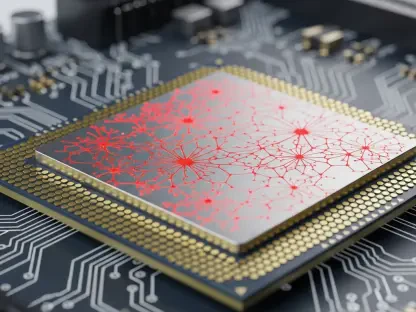
The next technological leap involves moving optics directly into the silicon package through Co-Packaged Optics (CPO). Upcoming Spectrum and Quantum switches are designed to integrate these transceivers, a move that slashes component counts and drastically reduces energy consumption. This integration is vital as datacenters face mounting pressure to optimize power usage while simultaneously increasing throughput for massive distributed training tasks.
This vertical integration strategy mirrors broader moves in the ecosystem, such as the substantial contributions to major AI labs. By stabilizing the hardware layer from the laser source up to the switch, the company provides a predictable roadmap for developers. This holistic approach ensures that the entire stack, from the physical light pulse to the software layer, is tuned for maximum efficiency and minimum latency.
Navigating the Shift to a Fiber-First Infrastructure
The industry is now preparing for an inevitable transition where fiber optic interconnects move from the rack-to-rack level down to the chip-to-chip level. While copper remains viable for internal rack platforms like the GB200 NVL72, the roadmap for distributed inference clearly points toward a fiber-first infrastructure. Preparing hardware portfolios today for this looming transition is the only way for datacenter operators to future-proof their massive capital investments.
Ultimately, the decision to deploy $4 billion into the optical supply chain stabilized the market by providing the long-term capital necessary for manufacturing breakthroughs. Engineers accelerated the development of pluggable modules and direct-fiber architectures that once seemed years away. This proactive approach addressed the scarcity of optical materials and ensured that the bandwidth requirements of the next generation were met before they became a crisis. Knowledge gained from this integration allowed for the creation of more resilient, energy-efficient clusters that successfully decoupled AI growth from the physical constraints of traditional electronics.