
The conversation around home security has been irrevocably altered by high-profile criminal cases, where the digital footprints left by modern systems have become indispensable investigative tools. When events such as the disappearance of Nancy Guthrie captured public attention, it became starkly clear that even a security system without an active data subscription could yield crucial evidence, shifting the homeowner’s perspective from mere deterrence to active participation in community safety. This renewed interest is not just about installing cameras; it’s about a fundamental re-evaluation of what it means to be secure in one’s own home, prompting a surge in demand for smarter, more integrated solutions. The industry has responded by transforming security from a utilitarian necessity into a sophisticated, almost invisible, layer of the modern luxury home, where advanced technology and elegant design converge seamlessly to offer unprecedented peace of mind.
The Evolution of Smart Security
The AI Revolution in Residential Safety
The connected home market is experiencing one of its most significant growth phases, driven largely by the rapid democratization of security technology. Innovations in artificial intelligence have been particularly transformative, bringing capabilities once reserved for high-security commercial facilities directly into residential settings. Features like AI-powered facial recognition, which can distinguish between family members and strangers, and smart zone detection, which allows homeowners to define specific areas for monitoring, are now readily available. This technological leap has fundamentally changed how security is perceived. According to industry experts like Jonathan Scott, AI has been the single most important catalyst in making systems more effective, intuitive, and less prone to false alarms. As a result, home security has shed its reputation as a clumsy, obtrusive add-on and is now viewed as an essential, integrated component of a thoughtfully designed living space, enhancing both safety and lifestyle.
A Paradigm Shift in Integration
The infusion of artificial intelligence into home security systems has catalyzed a significant paradigm shift, moving the entire concept from a functional afterthought to a core element of interior design and smart home architecture. Previously, homeowners and designers had to compromise, often hiding bulky sensors or conspicuous cameras that detracted from a home’s aesthetic. Today, AI-driven systems are designed with discretion in mind, offering powerful protection without visual intrusion. The intelligence of these systems means they can operate more subtly; for instance, instead of loud, disruptive alarms for minor events, they can send nuanced notifications to a homeowner’s smartphone. This capability allows for a more peaceful and controlled environment, where security enhances the living experience rather than detracts from it. This seamless integration ensures that a home can be both a fortress and a sanctuary, where advanced protection coexists harmoniously with sophisticated design principles.
Foundational Layers of a Modern System
Non-Negotiable Basic Sensors
At the core of any robust home security strategy lies a foundational, non-negotiable layer of protection: basic sensors. This essential first line of defense primarily consists of motion detectors and glass-break sensors, strategically placed to cover the most vulnerable entry points, such as ground-floor doors and windows. For years, the main drawback of these devices was their utilitarian appearance, which often clashed with refined interior designs. However, the industry has made remarkable strides in addressing this concern. Modern sensors are a world away from their bulky predecessors; they are smaller, often wireless, and boast clean, minimalist designs that can blend into their surroundings. This aesthetic evolution is crucial, as it allows for comprehensive security coverage without forcing homeowners to sacrifice their design vision. Designers now have the flexibility to integrate these devices in unobtrusive ways, ensuring the home’s architectural integrity remains intact while its perimeter is fully protected.
Enhanced Visual Verification
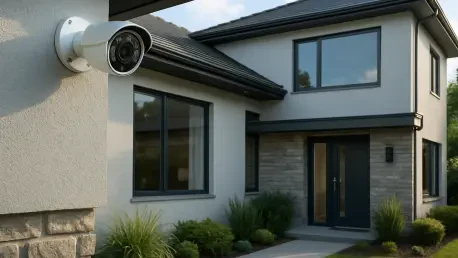
Building upon the foundational layer of sensors, the second tier of modern home security introduces visual verification through cameras, video doorbells, and smart locks. This level elevates a system from simply knowing that an event has occurred to seeing precisely who was involved and what happened. High-definition cameras and intelligent video doorbells serve as powerful deterrents, visibly signaling that a property is monitored while also acting as invaluable evidence-gathering tools. The ability to access live video feeds and receive real-time motion alerts on a mobile app provides homeowners with a direct connection to their property, whether they are at work or traveling abroad. Smart locks have also emerged as a game-changing component in this tier. While visually indistinguishable from their traditional counterparts, they offer a sophisticated blend of security and convenience, allowing for remote locking and unlocking via a smartphone. This fusion of visibility, control, and convenience makes for a formidable security posture that seamlessly complements a modern, connected lifestyle.
A Secured and Seamless Future
The integration of advanced security systems and interior design principles marked a pivotal moment for homeowners. What was once a relationship of compromise, where aesthetics were often sacrificed for safety, became a partnership of synergy. The development of discreet, wireless sensors and aesthetically pleasing cameras allowed these crucial components to be woven into a home’s architecture, rather than being conspicuously attached to it. Smart locks that blended traditional hardware design with remote accessibility provided convenience without disrupting the visual harmony of an entryway. This evolution ensured that creating a secure environment no longer meant living in a fortress of overt technology. Instead, security became an invisible, intelligent layer that enhanced the living experience, providing peace of mind while preserving the beauty and comfort of the home.