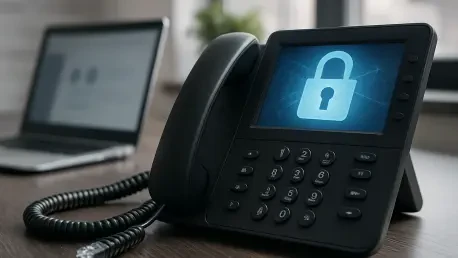

The discovery of a critical security vulnerability within the Grandstream GXP1600 series of Voice over Internet Protocol phones has sent ripples through the cybersecurity community, highlighting a significant oversight in how modern enterprises manage their hardware. This specific flaw, tracked as CVE-2026-2329, carries a staggering Common Vulnerability Scoring System rating of 9.3, placing it in the highest bracket of digital threats currently facing small and medium-sized businesses. For many years, organizations treated these desk phones as simple office utilities akin to a stapler or a lamp, yet the reality is that these devices are sophisticated, fully networked computers running specialized operating systems. This vulnerability allows for unauthenticated remote code execution, which effectively grants an external attacker total control over the physical hardware. Once compromised, these devices serve as a strategic entry point into the broader corporate network, bypassing traditional perimeter defenses that were never designed to police the internal behavior of a desk phone.
Technical Mechanics: The Anatomy of a Buffer Overflow
The technical core of this security crisis resides in a classic buffer-overflow vulnerability located within the web-based API service of the GXP1600 series. This specific interface was designed to streamline the remote management and configuration of the handsets, yet in many default configurations, the service remains entirely accessible over the network without requiring any form of user authentication. By sending a carefully crafted payload that exceeds the memory limits of the device’s input buffer, an adversary can trigger a state of memory corruption that facilitates the injection of malicious code. Because the vulnerable process operates with high-level administrative permissions, the resulting execution occurs with root-level privileges, the most powerful tier of access available. This bypasses every internal security hurdle within the device’s architecture, allowing the intruder to modify system files, install persistent backdoors, or disable logging mechanisms that might otherwise alert IT staff to the breach.
Moving beyond the initial system takeover, the exploitation of this flaw enables the mass extraction of sensitive Session Initiation Protocol credentials and plaintext passwords stored directly on the hardware. SIP serves as the primary signaling protocol for establishing and managing voice or video communications, making these credentials the keys to the kingdom for any telecommunications infrastructure. Once an attacker obtains these details, they can silently reroute incoming and outgoing traffic through a rogue proxy server, facilitating the covert interception of private business conversations. This capability allows for sophisticated industrial espionage where sensitive financial discussions or trade secrets can be harvested without a single audible click or interference in call quality. Furthermore, an adversary can leverage these compromised accounts to commit large-scale toll fraud, utilizing the company’s telephony resources to place expensive international calls, which often results in massive financial liabilities before the breach is even identified.
Lateral Movement: Turning Phones into Internal Spies
The most insidious aspect of a compromised VoIP phone is its role as a dark asset that typically exists outside the umbrella of standard endpoint protection and monitoring tools. While laptops and servers are usually outfitted with robust detection agents, desk phones are often neglected, making them ideal pivot points for lateral movement within a corporate environment. Once an attacker establishes a foothold on a Grandstream device, they can utilize its processing power to perform internal network reconnaissance, scanning for other vulnerable systems such as database servers or administrative workstations. This transformation of a benign office tool into a silent internal spy allows a threat actor to bypass external firewalls entirely, operating from a position of trust within the local network. By behaving like a legitimate piece of hardware, the compromised phone can beacon out to external command-and-control servers or move data across the network while remaining virtually invisible to traditional security software.
The risk associated with this vulnerability is significantly amplified for small and medium-sized businesses and the hospitality sector, where flat network architectures are unfortunately common. In these environments, every device from a guest-room phone to a back-office accounting computer resides on the same virtual network without internal barriers or segmentation. If a single handset in a public area like a hotel lobby or a shared workspace is compromised through CVE-2026-2329, the lack of internal firewalls provides the attacker with an unobstructed path to sensitive systems, including point-of-sale terminals and customer databases. These organizations frequently lack the dedicated cybersecurity personnel or the automated deployment tools required to manage patches across hundreds of disparate handsets. Consequently, a vulnerability that could be neutralized with a firmware update often remains unaddressed for months, leaving the entire organization’s digital infrastructure exposed to anyone who manages to gain access to the phone’s web interface.
Strategic Defense: Hardening the Voice Infrastructure
Mitigating the dangers of CVE-2026-2329 required an immediate and coordinated response starting with the deployment of the firmware patches released by Grandstream in early February. This update addressed the underlying memory corruption issue, effectively closing the door on unauthenticated remote code execution. However, the complexity of this task for large-scale deployments highlighted the need for more centralized management tools in the VoIP space. Organizations that relied on manual updates found themselves in a race against time, as automated exploit modules quickly became available to threat actors. This scenario demonstrated that simple patching is no longer a sufficient defense strategy on its own. Instead, businesses were forced to reconsider their entire approach to hardware security, treating every connected device with the same level of scrutiny usually reserved for high-traffic servers. This shift in mindset emphasized that firmware management is a continuous process rather than a one-time setup task.
The final strategy for long-term protection involved the implementation of rigorous network hardening and isolation techniques to limit the blast radius of any potential exploit. Administrators successfully moved their VoIP hardware onto dedicated Virtual Local Area Networks, which restricted communication between the phones and the rest of the corporate network. Furthermore, the use of Transport Layer Security for all SIP traffic ensured that even if a device was targeted, the communication remained encrypted and shielded from prying eyes. Security teams also established strict firewall rules that permitted web management access only from authorized administrative segments, effectively hiding the vulnerable API from general network traffic. By adopting these proactive measures, organizations transformed their voice infrastructure from a neglected liability into a secure and monitored component of the digital ecosystem. This comprehensive approach ensured that future vulnerabilities in embedded systems would not lead to catastrophic network-wide compromises.