
Listen to the Article
Ransomware and supply chain attacks have compressed the timeline defenders work against. ReliaQuest found that the average breakout time from initial access to lateral movement fell to 34 minutes in 2025, with the fastest intrusions reaching lateral movement in just 4 minutes and data exfiltration in as little as 6 minutes, which leaves little room for the slow, manual security processes many organizations still rely on. When lateral movement happens in near real time, a response that waits on ticket queues and business-hours staffing arrives too late to matter.
Closing that gap calls for a response framework that pairs human judgment with automated action, organized so that the right response happens at the right speed. Managed Detection and Response, or MDR, has become the practical answer for many businesses, supplying the continuous monitoring and fast intervention that internal teams often cannot sustain on their own. This piece examines how effective MDR programs structure authority, contain active threats, and strike a balance between automated speed and human control.
The Shift to Managed, Proactive Response
The change in the threat environment has forced a rethink of how much authority an organization delegates to its security partner. Detection alone accomplishes little if no one can act on it quickly, so the core of a modern program is a clear structure that lets analysts move from detection to investigation to containment without losing time to unnecessary approvals.
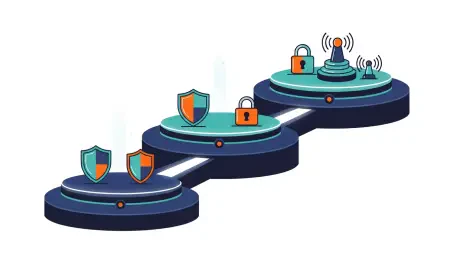
The organizing idea is to categorize response actions by the level of autonomy each one carries. Low-impact administrative tasks can run on their own. High-impact containment can be pre-authorized to trigger only under strict, high-confidence conditions. The most intrusive diagnostics stay under manual control and require explicit client approval. Security leaders are growing comfortable with exactly this division of labor, and a 2026 survey of more than 450 CISOs and SOC leaders found that 72% were already at ease letting fully autonomous systems handle medium-severity incidents and below, the high-volume alerts that fill most of the queue. This tiered model keeps operations moving at speed while matching the sensitivity of each action to the oversight it deserves, and it turns the security team from a passive monitor into an active defender that can change the environment as an incident unfolds.
Routine Forensic Actions Analysts Run On Their Own
Speed in an investigation depends on removing friction from the tasks that carry little risk. The first tier covers routine forensic work with negligible effect on business operations, which analysts can perform without waiting for sign-off.
Much of this is housekeeping that keeps an investigation coherent. Analysts link and unlink alerts to specific incidents so the attack path stays clear and the forensic trail remains usable. They manage exceptions within detection models to filter out known-benign activity and false positives, reducing alert fatigue and keeping attention on real signals, a real drain given peer-reviewed research documenting that around half of SOC teams feel overwhelmed by alert volume and that analysts spend over 25% of their time handling false positives. Technical steps that stop short of deep system access, such as capturing a memory dump from a particular endpoint process, also sit in this tier. None of these actions disrupt the business, and together they assemble the evidence a team needs to decide whether a more forceful response is warranted.
Containment When a Threat Is Active
Once an investigation confirms an active threat, the priority moves from watching to stopping. Critical response actions are the high-impact interventions that halt an adversary’s progress and cut off data exfiltration.
The most common of these is endpoint isolation, which severs a compromised machine from the wider network while keeping a controlled link to the management console so analysts can continue working on it. Disabling a compromised account performs the same function for stolen credentials, preventing an attacker from using legitimate logins to move through the environment or reach cloud resources. Because these steps can interrupt normal work, they are usually governed by auto-approval rules that fire only when specific, high-confidence conditions are met. That precision matters most during a ransomware outbreak, where each second of delay raises the odds of widespread system failure or irreversible data loss, and Sophos reports that 56% of ransomware attacks still succeeded in encrypting data in its latest study, up from 50% the year before.
Deeper Diagnostics on Request
Containment stops the immediate bleeding, but understanding the root cause and full reach of an intrusion takes deeper investigation. This third tier covers diagnostic tools that are more intrusive or complex than routine administrative work, and it stays under closer control as a result.
Analysts use custom YARA rules and PowerShell scripts to hunt for hidden indicators of compromise that signature-based detection tends to miss. Tools such as osquery let a team run structured queries across the entire fleet of endpoints to find unauthorized configuration changes or suspicious persistence mechanisms. Remote shell access goes further still, giving an analyst direct interaction with a system for manual file retrieval and hands-on examination of the file system. These capabilities demand a higher level of trust and are often activated manually by the client, and they are the tools that make it possible to root out persistent threats that have already slipped past the first lines of defense. The need is real, with Mandiant reporting a global median dwell time of 14 days in 2025 and a median of 122 days for cyber espionage and insider operations built for extreme persistence, some of which stayed hidden for more than a year by mimicking legitimate activity and erasing their own forensic traces.
Defending Identity and Email
Attackers concentrate on the identity layer and on communication channels because both offer durable footholds, which makes them priorities for response. When an account shows clear signs of abuse, such as sending internal spam or harvesting credentials, the response team needs the authority to disable that identity at once. Doing so ends the active session and blocks the attacker from re-authenticating elsewhere in the environment.
Email defense follows the same logic. The ability to quarantine malicious messages and block specific senders across the whole organization stops a phishing campaign from spreading and removes harmful attachments before other employees open them. The volume behind that threat is substantial, with Microsoft counting roughly 10.7 million business email compromise attacks in the first quarter of 2026 alone, many of them run through compromised accounts and phishing-as-a-service kits. Folding identity and email containment into the wider response plan closes the entry points and movement paths adversaries use most, which meaningfully shrinks the area a defender has to protect.
When Isolation Is Justified
The most intrusive actions are never taken casually. They follow rigorous criteria tied to observed adversary behavior, so that an aggressive response stays targeted rather than disruptive. Host isolation is generally reserved for a clear and present danger to the confidentiality or integrity of the environment. Signals such as credential-dumping tools, unusual data exfiltration, or command-and-control traffic typically justify pulling a host off the network at once.
Account disabling follows a similar standard, applied when the evidence that a set of credentials has been hijacked is unambiguous. That evidence is common, since Red Canary reports that identity attacks continued to dominate the threat landscape in 2025, with adversaries recognizing that compromising valid user accounts is more effective than exploiting technical vulnerabilities. Defining these triggers in advance lets analysts act with confidence, since each intervention is anchored to a specific risk rather than a hunch. The discipline keeps the defense both forceful and proportionate, and it limits needless interruption to legitimate work.
Building Resilience Into the Response Model
The maturity of a response program shows in how well it combines fast action with lasting insight. Tiered authority and advanced diagnostics together produce an infrastructure that absorbs attacks and recovers from them. Restoring connections quickly once a threat is neutralized keeps business continuity in view alongside security, so containment does not become its own source of disruption.
The forensic record built during an incident does further work after it ends. Collected evidence and virtual patching through specialized filter policies deepen an organization’s understanding of its weaknesses and help prevent similar incidents from recurring. A managed, proactive response framework of this kind gives decision-makers a dependable way to defend against sophisticated actors while keeping operations intact. For most enterprises, investment in this level of response maturity has become one of the clearer markers of whether an environment can hold up under pressure.