
A single, easily exploitable vulnerability within one of the world’s most popular file archiving tools has become the common weapon of choice for an astonishingly diverse range of global adversaries. The widespread adoption of this flaw, from elite state-sponsored espionage units to opportunistic cybercriminals, offers a compelling window into the modern dynamics of cyber warfare and the shared tactics that now define the digital battlefield. Research into this phenomenon reveals not just a technical weakness but a strategic convergence point for attackers of all motivations.
The Unifying Threat: A Single Flaw Exploited by All
An extensive analysis by Google’s Threat Intelligence Group (GTIG) brings into sharp focus the broad and active exploitation of a critical WinRAR vulnerability, CVE-2025-8088. The central challenge addressed by this research is understanding why this specific flaw has become a favored tool for such a diverse spectrum of threat actors. The investigation seeks to unravel what this convergence reveals about the modern threat landscape, where the lines between state-sponsored espionage and financially motivated cybercrime are increasingly blurred by the use of common tools and techniques.
This shared reliance on a single vulnerability highlights a critical shift in adversary behavior. The flaw’s appeal transcends geopolitical boundaries and financial motives, unifying disparate groups through a shared appreciation for its simplicity and effectiveness. The research demonstrates that the modern attacker’s calculus often prioritizes reliability and ease of use over novel, complex zero-days, creating a threat environment where a single unpatched application can expose an organization to a multitude of adversaries simultaneously.
Anatomy of a Critical Vulnerability: CVE-2025-8088
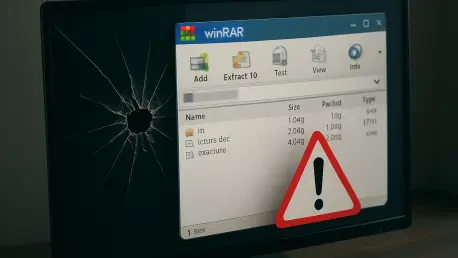
The investigation centers on CVE-2025-8088, a path traversal vulnerability in WinRAR that carries a high severity CVSS score of 8.8. Patched in version 7.13 in mid-2025, the flaw allows attackers to achieve arbitrary code execution through a deceptively simple mechanism. By crafting a malicious archive, an attacker can trick the application into extracting a payload into a sensitive location outside the intended destination folder, such as the Windows Startup folder, thereby establishing persistence on the compromised system.
The significance of this research lies in its clear demonstration of how a seemingly straightforward vulnerability in ubiquitous software can create a profound and widespread security risk. The attack requires minimal user interaction beyond the common action of opening an archive file, making it highly effective for phishing and social engineering campaigns. For the millions of users who fail to apply timely patches, this flaw represents an open door for attackers to gain a persistent foothold within their networks, underscoring a persistent gap between patch availability and deployment.
Research Methodology, Findings, and Implications
Methodology
The research is built upon a foundation of comprehensive threat intelligence analysis conducted by Google’s GTIG, complemented by initial discovery and reporting from the security firm ESET. The methodology involved a multi-pronged approach that included tracking the campaigns of known threat actors, meticulously analyzing malicious archive files to understand their construction, and reverse-engineering the malware payloads they delivered.
Furthermore, investigators monitored underground forums and marketplaces to trace the sale and discussion of the exploit. This comprehensive strategy provided a holistic view of the flaw’s exploitation lifecycle, from its initial use as a zero-day by a select few to its subsequent commoditization and widespread weaponization across the global threat landscape.
Findings
The research uncovered a stark convergence of disparate threat actors all exploiting CVE-2025-8088. On one side, nation-state groups were observed leveraging the flaw for espionage objectives. These included Russia-linked entities like Sandworm, Gamaredon, and Turla, which used the vulnerability to deploy payloads ranging from decoy documents to established malware suites like STOCKSTAY. A separate China-based actor was also identified using the flaw to deliver the notorious Poison Ivy remote access trojan.
Concurrently, financially motivated cybercrime groups rapidly adopted the same exploit for their own campaigns. The RomCom group, for instance, was found exploiting the vulnerability as a zero-day to install its SnipBot malware. Other criminal operations used it to distribute a variety of commodity malware, including AsyncRAT, and to deploy credential-stealing browser extensions specifically targeting users of Brazilian banking platforms.
Implications
The widespread and varied use of this single flaw highlights the increasing commoditization of the attack lifecycle. The availability of ready-to-use exploits from suppliers like the underground actor “zeroplayer” significantly lowers the barrier to entry, empowering less sophisticated actors to execute attacks that were once the domain of well-resourced teams. This trend blurs the lines of attribution and creates a formidable defensive challenge for organizations.
This market-driven proliferation of N-day vulnerabilities—flaws that have been patched but remain widely unmitigated—creates a significant defensive gap. The findings underscore the critical importance of implementing rapid patching cycles and fostering robust user awareness. Without these foundational security practices, organizations and individuals remain highly susceptible to a broad range of threats stemming from a single, known point of failure.
Reflection and Future Directions
Reflection
The study successfully illustrated the alarming speed and scale at which a single vulnerability can be weaponized across the entire threat ecosystem. A primary challenge encountered during the research was the difficulty in attributing specific campaigns with high confidence, precisely because the exploit’s widespread availability on underground markets meant it was no longer a unique signature of any single group.
While the research provides a deep dive into the WinRAR flaw, its scope could have been expanded to offer broader context. A comparative analysis of similar vulnerabilities in other widely used archiving utilities would help determine if this trend represents a systemic issue across a class of software or an anomaly specific to this particular exploit.
Future Directions
Future research should pivot toward a deeper investigation of the underground economy that facilitates the sale and distribution of N-day exploits. Understanding the supply chain, from exploit developers to brokers like “zeroplayer,” is essential for developing effective strategies to disrupt this market. Moreover, further exploration is needed to measure the real-world effectiveness of public awareness campaigns and to identify barriers to prompt patch deployment in both enterprise and consumer environments.
Technologically, the development of more robust, behavior-based detection methods for path traversal attacks originating from archive files remains a critical area for investigation. Such advancements would provide a crucial layer of defense that is not solely reliant on signature-based detection or the timely application of patches, offering protection against both known and future vulnerabilities of this nature.
A Critical Lesson in Cyber Defense: Patching and Persistence
The extensive exploitation of the WinRAR flaw served as a stark reminder of the immense power of a simple, reliable vulnerability. Its appeal to both spies and cybercriminals was rooted in its ability to consistently achieve persistence on a target system through a common and seemingly benign user action. This dual-use potential transformed a basic software bug into a universal key for a vast array of malicious campaigns.
Ultimately, this study reaffirmed that the foundation of modern cyber defense is not solely about preparing for sophisticated, unknown zero-days. Instead, it is equally, if not more, about the diligent and timely patching of known vulnerabilities in ubiquitous software. The persistent and widespread abuse of CVE-2025-8088 demonstrated that the most significant threats often arise not from what is unknown, but from what is known but left unfixed.